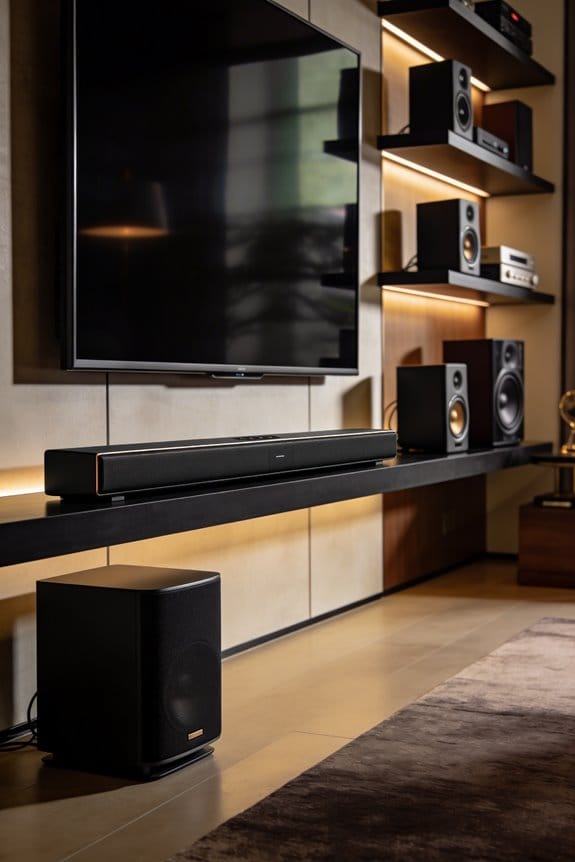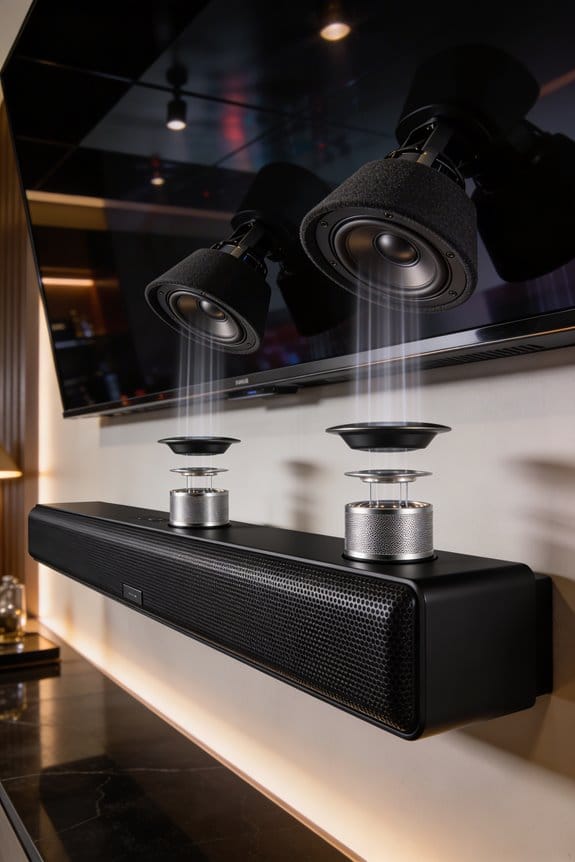
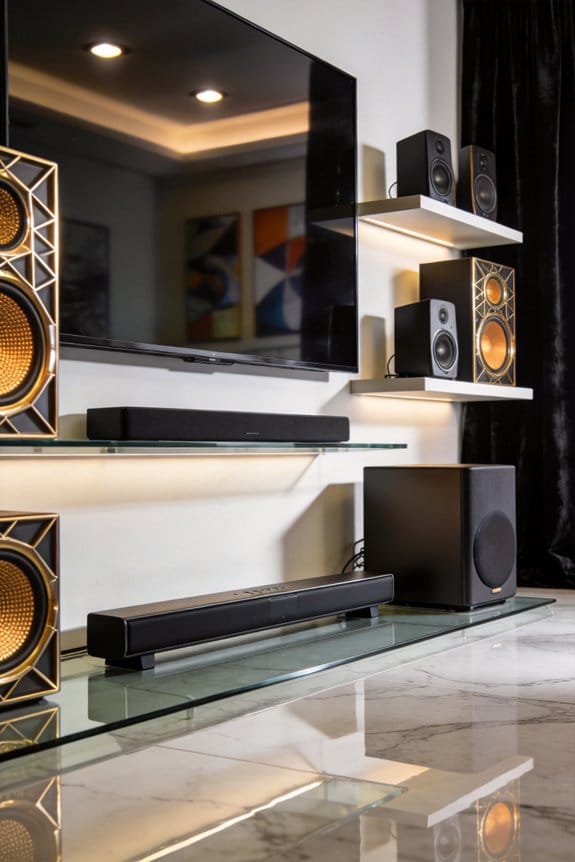

Traditional 5.1 and 7.1 systems can’t deliver overhead sound effects because their speakers sit at ear level, creating a flat soundscape that misses height information. I’ve found that Dolby Atmos changes this completely by using object-based audio that places sounds in three-dimensional space, including ceiling-mounted or upward-firing speakers in configurations like 9.2.6 channels. Modern AVRs decode these formats while AI-driven calibration automatically adjusts for your room’s acoustics, and compact wireless systems now make installation practical even in apartments. The sections below explain how each component works together to create this immersive experience.
Key Takeaways
- Traditional 5.1 and 7.1 systems lack overhead sound reproduction, creating flat listening experiences that miss immersive height effects.
- Dolby Atmos uses object-based audio to position sounds in three-dimensional space, enabling realistic overhead and surround sound movement.
- Height-channel configurations like 9.2.6 setups use ceiling-mounted and upward-firing speakers to create immersive vertical sound dimensions.
- AI-driven room correction technology automatically calibrates speaker output, optimizing acoustics through equalization, delay compensation, and level balancing.
- Modern compact wireless systems and advanced AV receivers simplify installation while delivering spatially accurate, cinema-quality immersive audio experiences.
Why Traditional 5.1 Systems Can’t Reproduce Overhead Sound Effects
Have you ever watched a movie or played a game where the sound effects felt flat? If you’re using a traditional 5.1 surround sound system, that’s probably why. These setups typically place all the speakers at ear level or below. When you do that, you miss out on those all-important overhead sound effects that can really suck you into the action.
With a standard 5.1 configuration, you’re working with a system of five speakers and a subwoofer. You’ve got your front left, center, front right, and the surround left and right. But here’s the catch: this setup can’t deliver any height information. So when something exciting happens above your head, like a helicopter flying overhead or rain pouring down, that sound just doesn’t come through. Instead, it flattens out into that horizontal plane, and you lose the immersive experience filmmakers want you to feel.
Want to truly enjoy modern content? It’s all about those advanced sound formats like Dolby Atmos and DTS:X. These formats use object-based audio, which means sound can actually move around in three-dimensional space, including above you. This makes a huge difference. It helps create a richer, more immersive listening experience, but without ceiling speakers or special upward-firing speakers, you’re missing out on the full effect.
So, what can you do? If you want to level up your audio, consider adding extra speakers or upgrading to a system that supports overhead sound. Whether you’re into movies, video games, or even just listening to music, it can totally change how you experience sound.
In short, traditional 5.1 systems just can’t deliver that overhead vibe. Think about how much more engaging your entertainment would be if you could actually hear sounds coming from above. Isn’t it worth looking into?
How Dolby Atmos Object-Based Audio Transforms Home Theater Immersion

Have you ever wondered why some home theater systems seem to pull you right into the action while others leave you feeling a bit flat? The difference often comes down to how sound is delivered. Dolby Atmos does this in a unique way that can truly elevate your movie nights. Instead of sticking with fixed audio channels like traditional systems, it uses something called object-based audio. This means every sound in a movie is treated as its own individual element, placed in a three-dimensional space.
You’ll find that sounds can move around and even above your head, creating a much more immersive experience. For instance, if it starts to rain in a scene, you can almost feel those droplets surrounding you. The magic happens thanks to the Dolby Atmos renderer, which figures out the best way to position each sound based on your specific speaker setup—whether you’ve got ceiling speakers, upward-firing modules, or some height-enabled speakers.
What’s really cool about this technology is how filmmakers can position sounds exactly where they want them. Imagine a helicopter flying directly overhead or ambient noises enveloping you from all sides. It’s not just about blasting sound; it’s about creating a realistic environment that pulls you into that world.
Compact 9.2.6-Channel Systems for Apartment-Friendly Installations

Building a home theater in an apartment can be a bit tricky. How do you create an immersive sound experience without cramming your limited space with bulky speakers? The Ultimea 9.2.6-channel system really addresses this tightrope walk with its smart, compact design. It includes a soundbar, four satellite speakers, and dual subwoofers—all in one neat package tailored for urban living.
What’s great about this setup is that it gives you height channels, surround effects, and solid bass without needing to mount anything on your walls or take up much floor space—both of which can be major headaches in an apartment. Plus, it comes with AI-driven calibration technology that fine-tunes the audio based on your room’s size, layout, and even your furniture placement.
Wireless connections between the components? Absolutely. This feature cuts down on the mess and hassle of running cables everywhere, which is a definite win for apartment dwellers. The best part is it delivers cinema-quality sound even in spaces under 200 square feet.
So, how can you make the most of this system? Frankly, it’s all about understanding your space and how to arrange your gear effectively. You don’t have to compromise on sound just because you live small.
How AI Calibration Fixes Bad Room Acoustics Automatically
Ever tried listening to your favorite music in a room with hard floors or bare walls? It can feel like the sound is bouncing around chaotically, leaving you with echo, muddy bass, and uneven volume no matter where you sit. If this sounds all too familiar, you’re not alone. Many people struggle with bad room acoustics, but there’s a solution: AI-driven room correction. It can actually measure your space and automatically adjust how your speakers sound.
Here’s how the acoustic optimization process generally goes:
- First, you place the calibration microphone at your main listening spot.
- Then, you run some automated test tones through each speaker.
- Next, let the AI do its thing by analyzing reflections, delays, and frequency response.
- Finally, check the adjustments made in your receiver’s settings menu.
So, what happens next? Systems like modern AVRs (audio-video receivers) can apply adjustments, like real-time equalization curves, delay compensation, and level balancing, depending on how your room is set up. You might be thinking, “Do I really need acoustic panels or bass traps anymore?” The truth is, when AI room correction is in play, these digital compensations tackle those annoying problem frequencies for you, all without requiring major structural changes.
Honestly, it’s a pretty straightforward process, and once you get everything set up, the improvement can be noticeable. So, why bother trying to tackle bad acoustics on your own when technology can do it for you? You’ll save time and effort, letting you enjoy your audio content the way it was meant to be heard.
In a nutshell, AI room correction can seriously enhance your listening experience. Are you ready to explore how it can transform your space?
Wireless Speakers That Eliminate Installation Complexity
Have you ever struggled with tangled speaker wires running through your home? It’s a hassle, right? Wireless speakers come to the rescue by letting you avoid all that mess. They send audio signals without the need for cables, which means you can cut down the setup time from what feels like forever to just a few minutes.
Take Samsung’s wireless Music Studio speakers, for example. They pair with compatible soundbars using special protocols, making your setup process super easy. Just place the speakers where you want them, plug them into a power source, and hit the pairing button in the menu—it’s that simple! This setup gives you great flexibility. Want to rearrange your living room? No problem. You can shift those satellite and surround speakers around without having to deal with a bunch of rewiring.
So, why does this matter? Dolby Atmos FlexConnect takes it a step further. It recalibrates the audio automatically whenever you move your speakers. This means you get top-notch sound quality no matter how you decide to arrange your room. Honestly, it puts traditional wired setups to shame when it comes to simplicity.
To wrap it up, wireless speakers are about making your life easier and giving you the freedom to enjoy your music without the headache of installation. Have you thought about ditching wires for a more convenient setup in your space?
AVRs and Processors That Power Height-Channel Audio Systems
Have you ever wondered what makes a home theater truly immersive? It all comes down to the AV receiver or processor that decodes and amplifies those impressive height-channel audio formats like Dolby Atmos and DTS:X. If you want to experience sound that literally surrounds you, you’ll want to check out modern AVRs such as the Sony TA-AN1000 and Marantz Cinema 30. These units have some cool innovations for height channels that let you feel like you’re right in the middle of the action.
When you set up one of these receivers, you’ll start with a 9.2.6-channel configuration. That means it sends unique audio signals to both ceiling-mounted speakers and upward-firing drivers, which bounce sound off your ceiling. To get this all working, you’ll need to dive into the setup menu. Don’t worry; it’s not rocket science!
So, what’s the trick to making sure everything sounds just right? First, calibrate the speaker distances and assign the amplifier channels to specific locations. This is where a processor does its magic. It’ll automatically analyze your room acoustics, tweaking delay times, crossover frequencies, and output levels. This optimization helps get spatial accuracy spot on.
Now, if you’re planning to set up multiple height channels, make sure to choose a receiver that has enough processing power. This is key for capturing those true overhead effects that can really elevate your audio experience. Honestly, it can make a world of difference.
Frequently Asked Questions
Can I Upgrade My Existing 5.1 System to Atmos Without Replacing Speakers?
Yes, I’d recommend adding height speakers or upward-firing modules to your existing setup. Dolby Atmos FlexConnect offers upgrade options with flexible speaker placement and automatic recalibration, letting you achieve immersive sound without completely replacing your current 5.1 system.
Do Streaming Services Compress Atmos Audio Quality Compared to Physical Media?
Streaming services noticeably compress audio fidelity compared to physical media’s lossless formats. I’ve noticed streaming codecs deliver diminished dynamic range and detail, while Blu-rays and Kaleidescape’s offerings preserve pristine, uncompressed Atmos tracks for true audiophile experiences.
How Much Does a Complete Immersive Audio System Cost for Beginners?
I’d estimate entry-level setups start around $500-$1,000 for basic Atmos soundbars with wireless subwoofers. Budget options like compact 5.1.2 systems offer immersive audio without breaking the bank, though premium systems can exceed $3,000 easily.
Will Wireless Audio Systems Have Noticeable Latency During Movies and Gaming?
Like a perfectly synced dance, modern wireless audio systems have virtually eliminated noticeable lag. Latency concerns are minimal now—wireless technology has advanced dramatically, delivering synchronized sound for movies and gaming without perceptible delays in premium systems.
Are 8K Displays Worth the Investment for Home Cinema Right Now?
I don’t think 8K displays are worth it yet. While 8K benefits include stunning clarity, there’s limited native content available. I’d recommend waiting until display technology advances further and more 8K content becomes accessible.