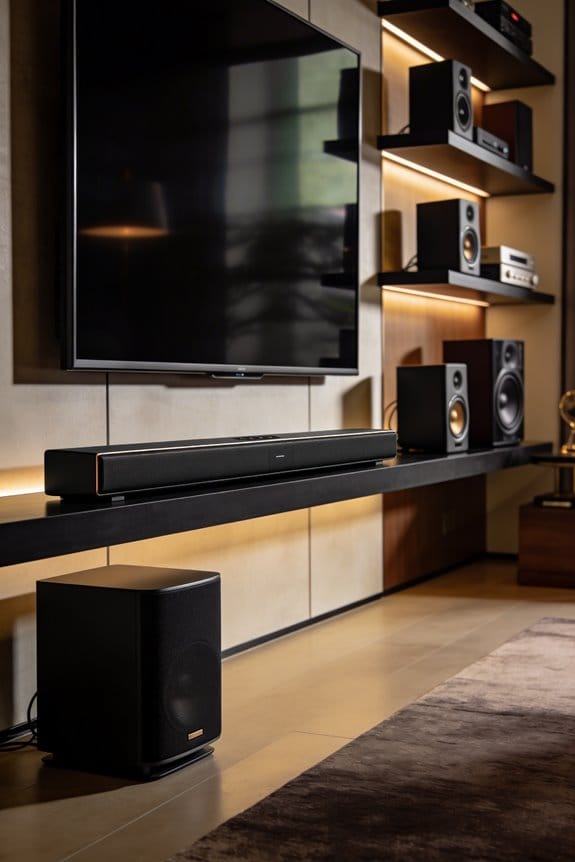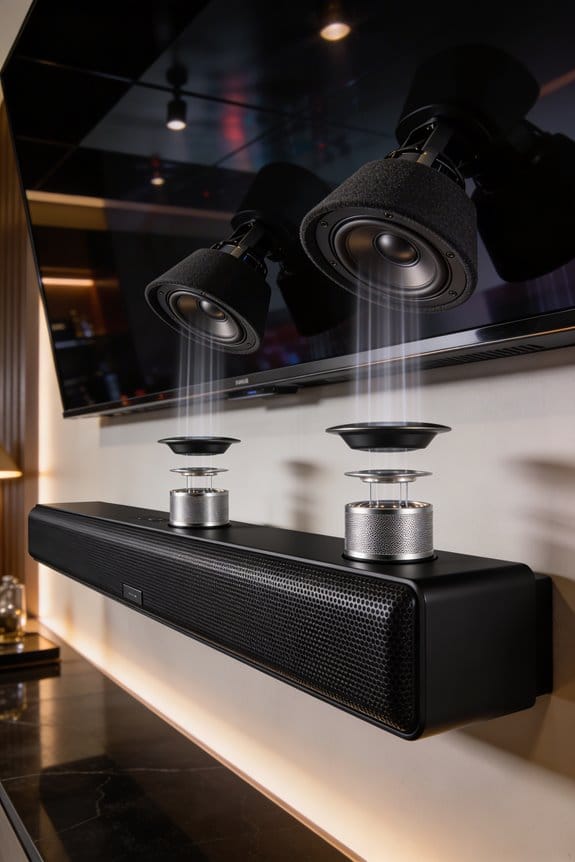

Console 3D audio differs from movie audio because it renders hundreds of sound sources in real-time based on your unpredictable movements and actions, while movies use pre-mixed spatial positions for passive viewing. The PS5’s Tempest Engine and Xbox’s spatial algorithms calculate audio each frame, adapting instantly to where you look, move, or shoot, creating dynamic soundscapes that respond to gameplay. Movie audio remains fixed regardless of viewer position, but console audio personalizes directional cues for competitive advantages and immersive exploration that I’ll explain further below.
Key Takeaways
- Console 3D audio adapts in real-time to player actions and movements, while movie audio follows a fixed, pre-mixed soundtrack.
- Gaming audio processes hundreds of sound sources each frame for interactive positioning, unlike static cinematic surround sound mixing.
- Next-gen consoles offer personalized audio profiles based on individual ear shape, a feature not available in movie audio systems.
- Console spatial audio creates dynamic soundscapes for gameplay advantages like detecting enemies, whereas movies prioritize narrative emotional impact.
- Gaming 3D audio enables sound-based navigation and environmental awareness, while film audio guides attention through predetermined directorial choices.
What 3D Audio Means for Console Gaming
When you’re diving into a next-gen game on either the PS5 or Xbox Series S, you might notice how the 3D audio technology really changes the way you experience sound. It’s like each sound is placed in a three-dimensional space around you, making it way easier to pick up on the little details, like enemy footsteps sneaking up behind you or gunfire coming from a specific direction. You’ll also be able to track vehicles gliding across the battlefield with a level of precision that wasn’t possible before.
The audio quality is a big leap forward compared to traditional stereo. Here’s the trick: technology like the PS5’s Tempest Engine and hardware-accelerated algorithms on Xbox work hard to process hundreds of sounds at once. This means you get positional accuracy that updates as you move. Sounds will shift based on where your character is, which way you’re facing, and even the kind of structures around you.
Have you ever tried playing in a quiet room versus with a gaming headset? The difference is huge! Good audio doesn’t just complement your adventure; it can actually change how you play and react in critical moments.
Frankly, if you’re serious about leveling up your gaming experience, trying out 3D audio is a solid move. It brings a whole new layer to the way you engage with every game, whether you’re exploring vast worlds or competing in high-stakes battles.
In short, the way sound works in games has changed for the better. Isn’t it time to immerse yourself in this richer audio experience?
Why Real-Time Audio Processing Changes Everything
Have you ever noticed how sound can pull you right into a game? Real-time audio processing really takes that experience to a new level. Instead of just playing a pre-mixed soundtrack like in movies, the sounds you hear in a game change on the fly. It’s like every action you make—turning around, stepping into a cave, or switching weapons—affects the audio around you.
The PS5’s Tempest Engine is designed to constantly calculate hundreds of sound sources at once. Every sound’s position, distance, and the impact of the environment are adjusted each frame. This means the audio reacts directly to what you’re doing, making the experience feel more immersive. Can you imagine how much that enhances gameplay when you hear a distant gunshot echo off a wall?
Meanwhile, Xbox’s hardware takes a similar approach with its own spatial sound algorithms that constantly update. Both systems are designed to manage reverb, occlusion, and directionality in real-time, ensuring those sounds adjust seamlessly as the game world shifts. It’s impressive—performance holds steady, which traditional surround sound systems struggle to achieve.
So, why does this matter? When you’re deep in the action and every sound aligns perfectly with your moves, it pulls you into the game like never before. You’re not just playing; you’re part of a living, breathing world.
In short, real-time audio changes everything about how we experience gaming prompts. Think about it—what are some of your favorite gaming moments where sound played a key role?
PS5 vs. Xbox: Direct 3D Audio Comparison
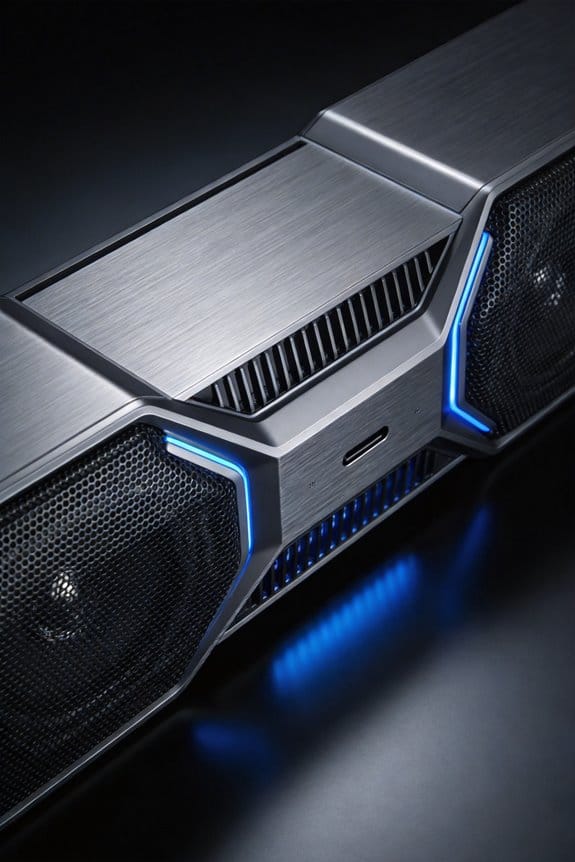
How do the PS5 and Xbox Series consoles actually stack up when you compare their 3D audio technologies side by side?
If you’ve ever played a game where sound plays a crucial role in your experience, you know how important good audio can be. The PS5 brings some interesting features to the table. For starters, it’s got this dedicated Tempest Engine chip. This little guy processes hundreds of 3D audio sources all at once, and it does it separately from the main GPU, which is pretty impressive. Plus, PS5 offers personalized audio profiles based on your ear and head shape. They even run a study with 100 people to come up with five profiles for you to choose from right at launch.
Now, let’s talk about the Xbox. It’s not that the Xbox Series consoles are falling flat, but they take a different approach with their audio. Instead of dedicated hardware like the PS5’s Tempest Engine, Xbox relies on software for sound processing. The Series S uses an algorithm-based method for its spatial sound. That’s not necessarily a bad thing, but you might miss out on some of the richer sound experiences you get from the PS5. The good news? Xbox supports Dolby Atmos and can process L-PCM up to 7.1 channels, Dolby Digital 5.1, and DTS 5.1 formats for traditional surround sound setups.
So, why does this matter? It’s all about how immersive your gaming experience will feel. If audio is key for you, the PS5’s dedicated hardware could push you towards the edge of your seat as you hear every subtle sound in the game.
Ultimately, both consoles have their strengths and weaknesses. The PS5 shines with its specialized features, while Xbox offers compatibility with established audio formats. It really boils down to what you value more in your gaming setup. Are you ready to prioritize immersive sound, or do you prefer flexibility with traditional surround sound? Think about what matters to you when choosing your console.
Tempest Engine: How PS5 Handles Hundreds of Sound Sources
Ever found yourself in a game and thought, “Wow, I wish I could hear that footstep clearer?” Well, if you’re gaming on a PS5, the solution could lie in its Tempest Engine. Unlike the Xbox Series which primarily relies on software for sound, the PS5 goes all-in by using a dedicated hardware chip just for 3D audio processing.
This means the console can manage hundreds of sound sources at once, all in real-time. Think about that—it calculates where sounds are coming from, how far away they are, and how they interact with the environment. The result? An immersive audio experience that traditional methods just can’t match.
Key Technical Capabilities
- It can process a ton of individual 3D audio sources at the same time.
- No need to fuss over settings; it automatically adapts to whatever you’re using—headphones, TV speakers, or surround sound systems.
- If you’re all about that spatial awareness, it creates personalized audio profiles for you.
Here’s the trick: you can actually choose from five launch profiles, tested on 100 people by Sony. Each profile is tailored to different ear and head shapes, which means you’re likely to get better directional accuracy.
So, why does this matter? Because hearing those subtle sounds can make a huge difference in gameplay. Imagine being able to pinpoint exactly where that enemy is sneaking up on you.
Truth is, when you dive into games with the PS5’s Tempest Engine, it’s like stepping into a new world. If you’ve been gaming with flat sound, you owe it to yourself to experience this. In the end, better sound can really enhance your overall gaming enjoyment. What’s your experience with 3D audio?
Xbox Spatial Sound: Atmos Integration and Algorithm Power
When you fire up your Xbox Series console, the spatial sound experience you get is pretty impressive. Unlike Sony’s setup with dedicated hardware chips, Xbox leans on powerful algorithms to create immersive audio that pulls you right into the action.
Atmos Benefits
With the integration of Dolby Atmos, you’ll notice that the sound isn’t just loud; it positions audio elements around you in a way that feels real. Think about it: whether you’re using headphones, your TV speakers, or a full surround system, you’ll be surrounded by sound that moves around you. It supports various formats like L-PCM up to 7.1, Dolby Digital 5.1, and DTS 5.1, allowing for a rich audio experience that really enhances gameplay.
Algorithm Efficiency
What sets this system apart is how it uses the hardware within the Series S and X consoles to process sound in real-time. This means it doesn’t need extra audio chips to deliver the goods. The best part? You’re always at the center of the action, as the system adapts to whatever’s happening in the game while keeping everything smooth at 60fps and 4K resolution.
So, why does this matter? Well, it makes for a seamless gaming experience, letting you focus more on playing and less on tech issues. Honestly, if you’re serious about your gaming, you’ll want to take advantage of the sound features Xbox brings to the table.
Dedicated Audio Chips vs. Software Solutions
So, let’s talk about something that’s often overlooked—audio quality in gaming. Ever wonder how some games manage to create such immersive soundscapes while others fall flat? That’s where the big players, Xbox and Sony, differ significantly.
While Xbox leans on sophisticated algorithms to deliver its spatial sound, Sony zigged when they built the PS5. They introduced the Tempest Engine, a dedicated audio chip designed specifically for processing sound. Instead of crunching numbers on the main processor like Xbox does, this chip—originally re-engineered from an AMD GPU compute unit—handles dozens of simultaneous 3D audio sources seamlessly.
You might be asking yourself: “What’s the big deal?” Well, the dedicated hardware ensures that audio remains consistent, no matter how demanding the game gets. On the flip side, Xbox’s software-based approach gives it flexibility; it supports various audio formats like Dolby Atmos.
Both methods deliver accurate sound positioning, but they do so in very different ways. Sony’s hardware offers reliability while Xbox plays more with its software algorithms.
Personalization: Ear Profiles, Output Flexibility, and Custom Tuning
Have you ever put on headphones and thought, “Why does this sound so different for me compared to my friend?” That’s because everyone’s ears are shaped in their own unique way. The PS5 has a cool feature that takes this into account by letting you create personalized audio profiles. Sony even based their five launch profiles on a study involving 100 people, so you can choose one that suits your hearing best from the console’s sound settings. This means the audio can hit your ears at the right angles and frequencies, making for a more accurate listening experience.
On the flip side, the Xbox Series S handles audio profiles a little differently. Instead of customizing for personal ear shapes, Xbox uses Dolby Atmos integration. Both consoles are pretty smart, adjusting audio output no matter if you’re using headphones, TV speakers, or a surround system. Still, the PS5’s method is focused on your anatomy, while Xbox uses a broader algorithm that works across any setup.
So, why does this matter? If you really want to enjoy your games with all the clarity, you might want to give those personalized audio profiles a shot on the PS5. Honestly, considering how different we all hear, it could be worth exploring.
3D Audio in Action: No Man’s Sky, VR, and Competitive Gaming
Are you tired of missing sounds in games that can cost you your life? Real-world games like No Man’s Sky on the PS5 really show how impressive 3D audio technology can be. When you fly through space or land on a new planet, you’ll notice a huge difference. Thanks to the Tempest Engine, the game processes tons of audio sources at once, letting you hear creatures, environmental dangers, and even other players just by sound. This really makes a difference in competitive play, where being aware of what’s around you can mean the difference between winning and losing.
If you’re into VR, you’re in luck. The PS5’s backwards compatibility gives PSVR titles full 3D audio support. So, what does that mean for you? Well, you can track enemies moving behind walls, find objectives without depending on visual cues, and react to changes in your environment way quicker than with regular stereo sound. Plus, the positional accuracy adjusts seamlessly as you explore different areas, which is crucial in these immersive experiences.
Honestly, the audio landscape in games has upgraded to a new level. It’s not just about recognizing sound anymore; it’s about using it to your advantage. You’ll find that every little sound can be a clue in navigating through your gaming world. So, why does this matter? Because realizing where threats are just by listening can shape how you play and interact in these games.
Frequently Asked Questions
Can I Use My Existing Home Theater Receiver With Console 3D Audio?
Like plugging a new gaming console into your familiar TV, I can confirm your existing receiver works with console 3D audio. However, 3D audio compatibility and ideal home theater setup performance depend on whether your receiver supports modern formats like Dolby Atmos.
Does 3D Audio Work With Game Streaming Services Like Xbox Cloud Gaming?
Game streaming services support 3D audio, but I’ve noticed audio performance depends on your internet connection quality. Compressed streaming can reduce spatial accuracy compared to native console gameplay, though it’s still considerably better than traditional stereo sound.
Will Older Games Receive 3D Audio Updates or Just New Releases?
Like resurrecting old classics with a fresh coat of paint, I’ve seen both happen. Game compatibility varies—some older titles receive 3D audio patches, but update limitations exist. Developers must manually retrofit the technology, so new releases more commonly feature it natively.
How Much Does Dolby Atmos Licensing Cost for Xbox Users Annually?
I’ll tell you that Dolby Atmos costs $14.99 as a one-time purchase for Xbox, not annually. You’ll enjoy significant Dolby Atmos benefits and Xbox audio enhancements across games and entertainment without recurring fees.
Can I Create Custom Audio Profiles Without Using Preset Options?
I can’t create fully custom audio settings on PS5 beyond five preset profiles, though Sony mentioned potential photo-based customization. Xbox doesn’t offer personalized gaming audio preferences either—you’ll adjust standard spatial sound options instead.