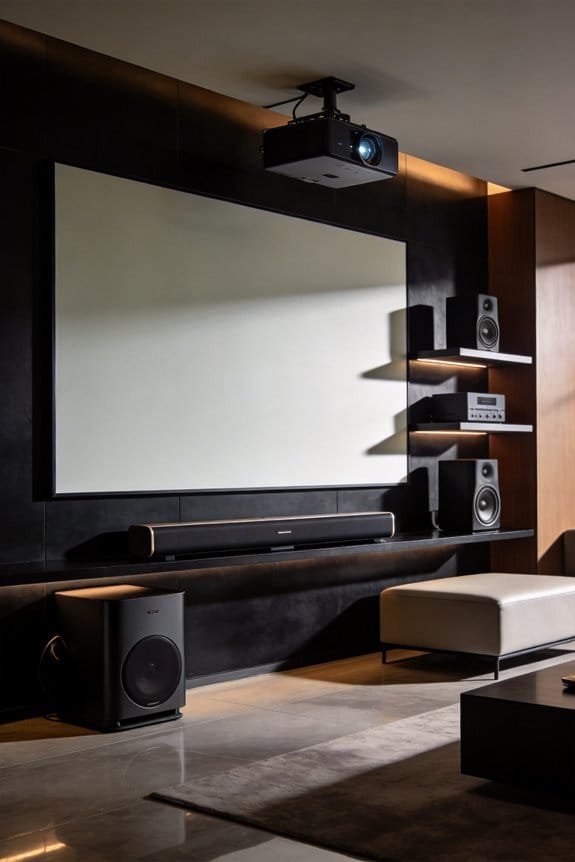
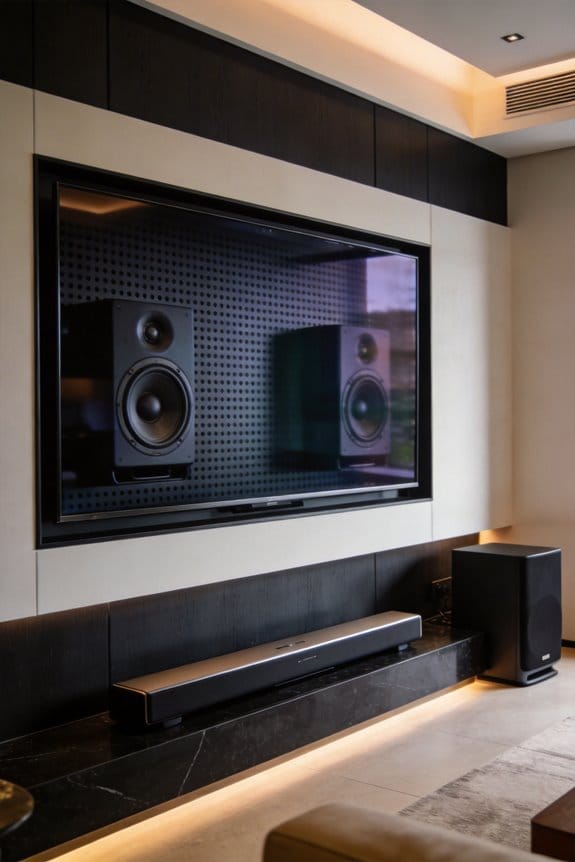

Acoustically transparent screens let you place speakers directly behind your projection surface, just like commercial cinemas do, by using perforations or woven materials that allow sound waves to pass through with minimal loss. I’ll explain that these screens feature either tiny precision holes, up to 30,000 per square foot, or woven fabric with natural gaps between fibers. You’ll experience an average sound reduction of only 3 dB while maintaining dialogue clarity and immersive audio that aligns perfectly with on-screen action. The following sections break down screen types, installation requirements, and pricing from $1,500 to $8,000.
Key Takeaways
- Acoustically transparent screens feature perforations or woven gaps allowing speakers to be hidden behind them without compromising sound quality.
- These screens maintain minimal sound loss (approximately -3 dB) while delivering immersive audio that aligns perfectly with on-screen action.
- Two main types exist: woven screens using coarse fabric and perforated screens with up to 30,000 precision holes per square foot.
- Installation takes 2-4 hours with basic tools, requiring accurate measurements and brackets spaced 24-48 inches apart for stability.
- Prices range from $1,500 to $8,000, with premium models offering advanced materials, superior color balance, and tensioning systems.
What Is an Acoustically Transparent Screen?
Have you ever watched a movie and thought the sound was just a bit off? It can be frustrating when what you see on the screen doesn’t match up with what you hear. That’s where an acoustically transparent screen comes in.
These screens are designed with tiny perforations or woven gaps, allowing sound waves to easily travel through. This means you can actually place your speakers behind the screen without a noticeable drop in sound quality. It’s like bringing the cinematic experience right into your living room, with audio that feels perfectly synced to the action on screen.
Here are a few reasons to consider this option:
- Invisible speakers: You can hide your speakers, keeping your room looking sleek and uncluttered.
- Better dialogue clarity: When center channel speakers sit directly behind the screen, you’ll hear dialogue more clearly, making that intense movie moment even more impactful.
- Immersive sound: The audio seems to come from the exact spot where the characters are, adding to the overall experience.
The perforation patterns in these screens are usually diamond-shaped, which helps prevent pesky issues like moiré interference that can mess with projected images.
So, why does this matter? If you’re setting up a media room, having that seamless audio-visual connection can make a huge difference in how you enjoy films. It’s like creating your own mini theater at home!
In short, acoustically transparent screens can really enhance your viewing experience by making sound feel more natural and immersive. Have you thought about how much a good screen could improve your movie nights?
Why Acoustically Transparent Screens Transform Home Theater Sound

Acoustic transparent materials are pretty neat because they keep sound loss to a minimum, usually around -3.09 dB. This means you can enjoy your favorite movies and music with clear, precise sound direction, which is something you just don’t get with regular speaker setups.
So, why does this matter? When you’re watching an action-packed film or listening to your favorite tunes, every detail counts. If you’ve ever tried to maximize your home theater experience, you know that sound quality can make or break the vibe. By using materials that allow sound waves to pass through without getting muddled, you can create a setup that’ll have you feeling like you’re right in the middle of the action.
Here’s the trick: when choosing your acoustic transparent screens, look for options that offer good quality while being easy on the eyes. You want something that blends nicely with your decor but doesn’t skimp on sound fidelity.
The best part is that these screens help retain that crispness and clarity, making every note and sound effective. You can catch each whisper and crash, bringing out the emotional highs and lows that a standard screen might muffle.
Honestly, it’s all about creating an immersive experience. Imagine hearing every footstep in a thriller or the subtle notes of a soundtrack that adds to the emotion of a scene. It’s these little things that enhance your overall enjoyment.
Woven vs. Perforated: How These Screens Let Sound Through

Now that you’ve got a handle on how acoustic transparent screens keep sound quality intact with minimal loss, let’s dive into the two main construction methods that make this work.
Woven Screen Construction
Woven screens are made from coarse fabric fibers that naturally create small gaps between the threads. This design allows sound waves to pass through without significantly changing them. The best part? They maintain excellent audio quality across all frequencies without needing any extra holes punched in. Isn’t that cool?
Perforated Screen Design
On the other hand, perforated screens come with some seriously tiny holes—some as small as twenty-thousandths of an inch! These screens can have more than 30,000 perforations per square foot arranged in diamond shapes to prevent unwanted visual effects while still providing clarity. It’s pretty impressive how the density of these perforations affects both sound and light. You want to make sure those openings let sound through but don’t let too much light reflect from what’s behind the screen. So, why does this matter? It could make or break your home theater experience!
To wrap it up, woven and perforated screens each come with their own benefits when it comes to sound and picture clarity. What do you think would work best for your setup?
Will You See Perforations or Weave Patterns on Your Screen?
Are you worried about seeing holes or weave patterns on your acoustic transparent screen? It’s a common concern for anyone who wants a distraction-free viewing experience. The reality is that whether or not you notice these details depends on a few factors, like how far you sit from the screen, the screen’s perforation density, and the resolution of your projector.
Here’s the scoop: You’ll generally stop seeing those pesky perforations when you sit more than 1.5 times the width of the screen away. Modern screens have over 30,000 tiny holes per square foot, often so small that they just blend into the background during normal viewing.
Think about how the screen is made. Tighter fabric construction and keeping the screen tensioned can really help with how it looks. If you’re looking for minimal pattern visibility, aim for screens that feature diamond-shaped perforation patterns or angular weaves. These designs do a good job of reducing moiré effects and other visual artifacts, especially with high-definition content.
So, why does this matter? You want to enjoy your movies, sports, or games without distractions, right? Pay attention to these details, and you’ll get a screen that enhances your viewing experience rather than detracting from it.
In the end, finding the right acoustic transparent screen is about striking the right balance. Have you thought about your ideal viewing setup?
How Much Sound Quality Do You Lose Through the Screen?
Have you ever wondered how much sound quality you actually lose when sound passes through a screen? It’s a common concern, especially for those looking to optimize their home theater experience.
When it comes to measuring the sound quality, experts often look at something called sound pressure level (SPL). This basically compares how sound performs when it’s passing through a screen versus when there’s nothing in the way. Luckily, high-quality acoustic transparent materials do a fantastic job here, maintaining an average sound loss of just about -3.09 dB. Most people can’t even tell the difference during a regular movie night.
This slight attenuation happens all across the audio spectrum. The best part is that woven and perforated screens are designed to keep audio quality high. They don’t mess with the sound waves too much, so you can expect that your dialogue will remain clear and immersive, making your viewing experience much more enjoyable.
So, why does this matter? If you’re someone who loves crisp sound without having to compromise aesthetics, you’ll want to consider going for a good acoustic screen.
Honestly, the sound pressure reduction is consistent, so you can focus on what really matters—your favorite movies and shows—without worrying about losing clarity or depth in the audio.
To wrap it up, being mindful about your screen choice can make a big difference in your home theater setup. Have you thought about how what you see might be affecting what you hear?
Woven or Perforated: Which Screen Type Fits Your Setup?
When setting up your home theater, have you ever wondered whether a woven or perforated acoustic screen is the better choice for you? It’s a bit tricky, right? The decision really hinges on what you’re trying to achieve with your space, from speaker placement to how you like to watch movies.
Woven screens have woven fabric with natural gaps that let sound travel through, preserving the audio quality across different frequencies without altering the sound waves too much. This is a plus if you’re after great sound performance, as they typically show about -3.09 dB attenuation. It’s solid sound quality. But then there’s the perforated screens, which feature holes punched with precision – sometimes over 30,000 holes per square foot! They help avoid moiré effects, which is a game-ender for image clarity.
Take a moment to assess how well your projector’s resolution and brightness align with your screen options. Both screen types usually maintain a gain between 0.8-1.3, which is pretty decent. If you’re leaning towards fantastic sound transmission, woven screens might be your best bet. On the flip side, if you need consistent image sharpness, perforated screens are the way to go.
Consider your room acoustics and speaker power, too. Do you value clear dialogue over image sharpness? Or vice versa? Honestly, it’s all about your priorities and what fits your setup best.
In the end, weigh your options carefully. Whether you go woven or perforated, the choice can shape the vibe of your home theater. What’s the one element you don’t want to compromise on during movie night?
Can You Install an Acoustically Transparent Screen Yourself?
Can You Install an Acoustically Transparent Screen Yourself?
So, you’ve decided to go for an acoustically transparent screen? That’s awesome! But maybe you’re wondering if you can actually install it yourself. Rest assured, it’s totally doable if you’ve got some basic tools, a bit of spatial awareness, and the patience to follow instructions.
Here’s the deal: Start by measuring your wall space accurately. You’ll want to know exactly where the screen will go. A stud finder is your best friend in this situation; it’ll help you locate the wall studs, which are crucial for mounting the screen securely. Once you’ve got that down, grab a level tool to mark your mounting points precisely—this step is key to avoid a crooked screen.
When it comes to actually mounting the screen, it’s all about securing brackets at the right heights. Typically, you’ll want those brackets spaced about 24-48 inches apart, depending on the width of your screen. A few lag bolts driven into sturdy studs will give you the support your screen needs. You’ll need a power drill, the right drill bits, measuring tape, and it’s a good idea to have a buddy help you lift those larger screens into place.
Most manufacturers make this easier by including detailed instructions along with the mounting hardware and any tension systems or adjustment mechanisms. The best part is, if you follow these guidelines, you can get this entire project wrapped up in about 2-4 hours, depending on the size of your screen and how complex the mounting setup is.
Truth is, tackling the installation yourself not only saves you some cash but also gives you a great feeling of accomplishment. So, are you ready to transform your space? Give it a go—you might just surprise yourself!
Acoustically Transparent Screen Prices: $1,500–$8,000 and What You Get
Finding the right acoustically transparent screen for your home theater can feel overwhelming, especially with prices ranging from $1,500 to $8,000. So, what makes a $1,500 screen different from a fancy $8,000 one? Let’s break it down.
First off, entry-level woven screens priced between $1,500 and $3,000 give you the basic benefits of acoustic transparency. With a mean attenuation around -3.0 dB, these screens work well for 100-inch diagonal setups in standard home theaters. If you’re just getting started and want a decent quality screen without breaking the bank, these can be a good fit.
Now, if you’re ready to invest a bit more, consider mid-range perforated models that fall in the $3,000 to $5,500 range. These screens have precision perforation patterns, boasting over 30,000 holes per square foot. What’s the benefit? They help reduce moiré effects and still keep a screen gain between 0.8 and 1.3, giving you a more cinematic experience.
But, let’s talk about premium options—these are the big leagues, priced between $5,500 and $8,000. They typically use advanced materials with diamond-shaped perforations, offering superior color balance that works wonders with 4K projectors. Plus, these screens come with tensioning systems that keep them perfectly flat. It’s about that crisp, clear picture with minimal light reflection from whatever’s behind the screen. So, why does this matter? Well, better frequency response means you hear the audio exactly as it was intended.
When choosing a screen, it’s smart to weigh the quality of materials and design, especially at the higher end. A better screen can breathe life into your movies and shows, making that extra spend worthwhile.
In short, whether you go for something entry-level or splurge on a premium model, consider what matters most to you in your home theater experience. What’s your top priority: budget, sound quality, or visual clarity?
Frequently Asked Questions
Do Acoustically Transparent Screens Work With Ultra Short Throw Projectors?
I’ve found that acoustically transparent screens work excellently with ultra short throw projectors. The screen placement requires careful positioning since UST projectors sit close to the screen’s base, but the acoustic performance remains uncompromised throughout your setup.
Can I Use an Acoustically Transparent Screen With Ambient Light Rejecting Technology?
Yes, I can confirm you’ll find screens combining both features, though they’re less common. Ambient light rejecting technology and acoustic transparency can coexist, but verify projector compatibility since these specialized dual-function screens may affect brightness and require specific throw distances.
How Much Space Do I Need Behind the Screen for Speakers?
I’d recommend allowing at least 12-18 inches of screen distance behind your acoustically transparent material for proper speaker placement. This spacing guarantees adequate sound dispersion and prevents audio reflections while maintaining ideal acoustic performance for your setup.
Will My Subwoofer Also Work Behind an Acoustically Transparent Screen?
Want ideal bass response? I’d recommend against subwoofer placement behind your screen. While screen materials allow higher frequencies through effectively, subwoofers perform best when positioned flexibly around your room for superior low-frequency distribution and impact.
Do Acoustically Transparent Screens Require Special Cleaning or Maintenance Procedures?
I’ll share that acoustically transparent screens don’t need special procedures beyond standard maintenance tips. Regular cleaning techniques like gentle dusting and occasional wiping with appropriate solutions work perfectly fine for preserving both acoustic performance and image quality.