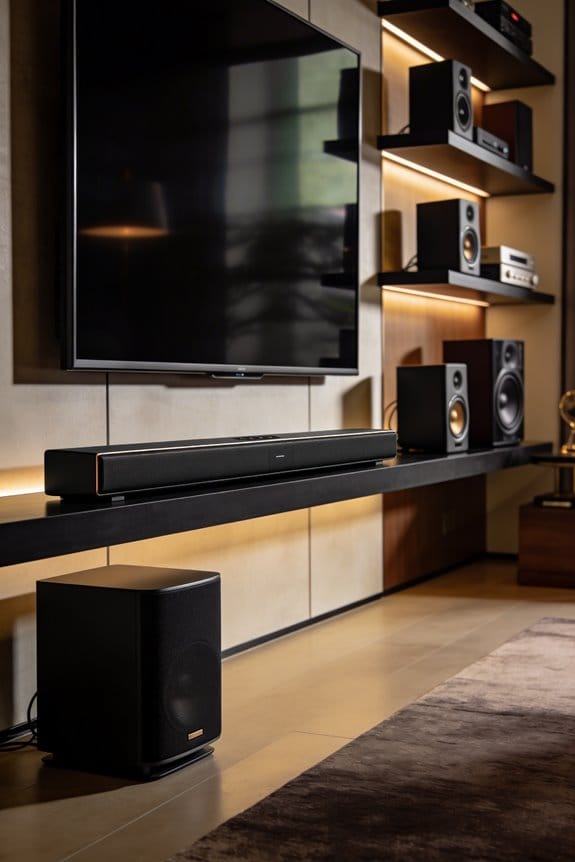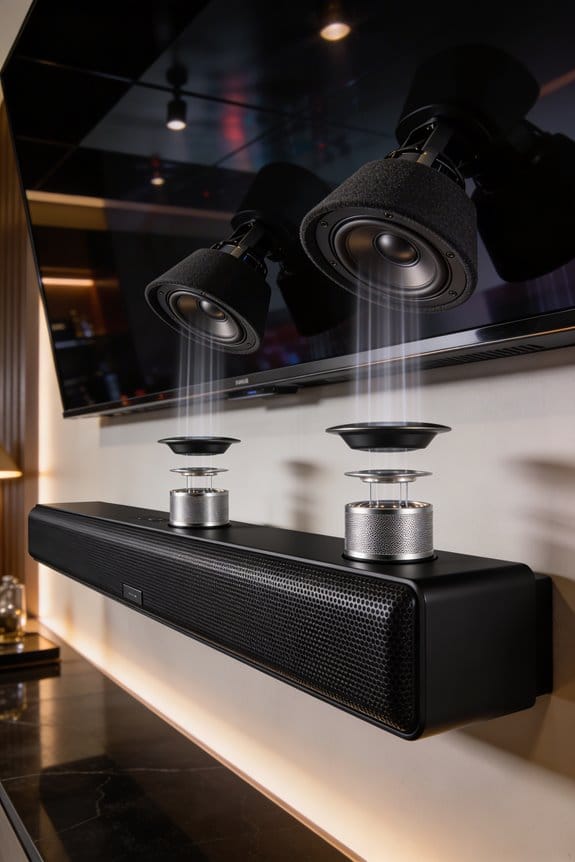
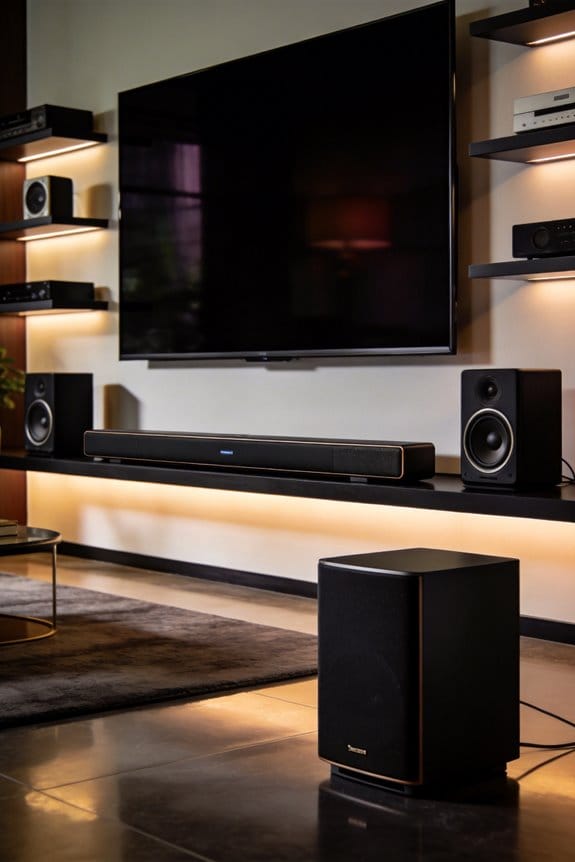

I’ll explain how psychoacoustics transforms soundbar design by leveraging your brain’s natural audio processing instead of requiring multiple speakers. Modern soundbars use virtualization algorithms that transmit different signals from four or fewer drivers, tricking your auditory system into perceiving surround sound from multiple directions. They adjust frequencies based on Fletcher-Munson curves, which balance bass and treble at various volumes, while smart compression maintains dialogue clarity during dynamic scenes. Up-firing drivers bounce sound off ceilings to simulate overhead effects without dedicated Atmos speakers. The sections below break down each psychoacoustic principle manufacturers now integrate into hardware design.
Key Takeaways
- Soundbars use psychoacoustic virtualization to create surround sound with fewer drivers, tricking the brain into perceiving multi-directional audio.
- Fletcher-Munson curves guide frequency adjustments based on volume levels, ensuring balanced bass, treble, and clear dialogue at any listening level.
- Up-firing drivers exploit ceiling reflections to simulate overhead audio, implementing Dolby Atmos for immersive three-dimensional sound experiences.
- Smart volume compression maintains consistent audio levels, keeping dialogue clear while reducing jarring transitions between quiet and loud scenes.
- Modern processors integrate psychoacoustic algorithms to optimize spatial audio and tonality, delivering superior sound quality without additional speakers.
How Psychoacoustics Eliminates the Need for Multiple Speakers
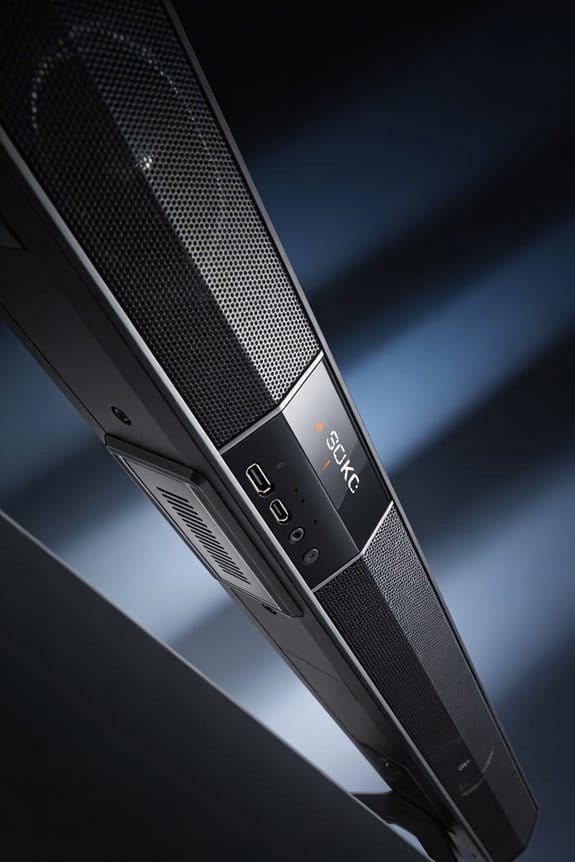
Have you ever walked into a room filled with speakers, only to wonder if it’s really worth the hassle? If you’re tired of dealing with tangled wires and bulky setups, soundbars could be your answer. They work by using something called psychoacoustic virtualization, which makes it possible to enjoy great sound without the need for multiple speakers like those traditional home theater systems.
So, how does this magic happen? It’s all about transmitting different audio signals from each driver at just the right moments. This technique tricks your brain into experiencing a wider sound field than you might expect from a single unit. Believe it or not, a soundbar equipped with just four drivers can create surround sound effects that rival more complex systems which have two. In fact, any setup with five or fewer speakers generally uses some form of this virtualization.
What makes this even more appealing is how the technology works with the arrangement of the drivers. Modern processors integrate these sound algorithms, making it easier to develop and ensuring high output quality. So when you hear that immersive audio from just one slim device, it’s actually thanks to some clever tech working behind the scenes.
Honestly, this means it’s easier than ever to enjoy a movie night or jam out to your favorite playlist without the clutter. You won’t have to spend a fortune on installing multiple speakers around your living space.
To sum it up, soundbars serve up rich, surround sound experiences from a compact design, simplifying your audio setup. Have you tried making the switch yet?
How Virtualization Simulates Surround Sound With Fewer Drivers
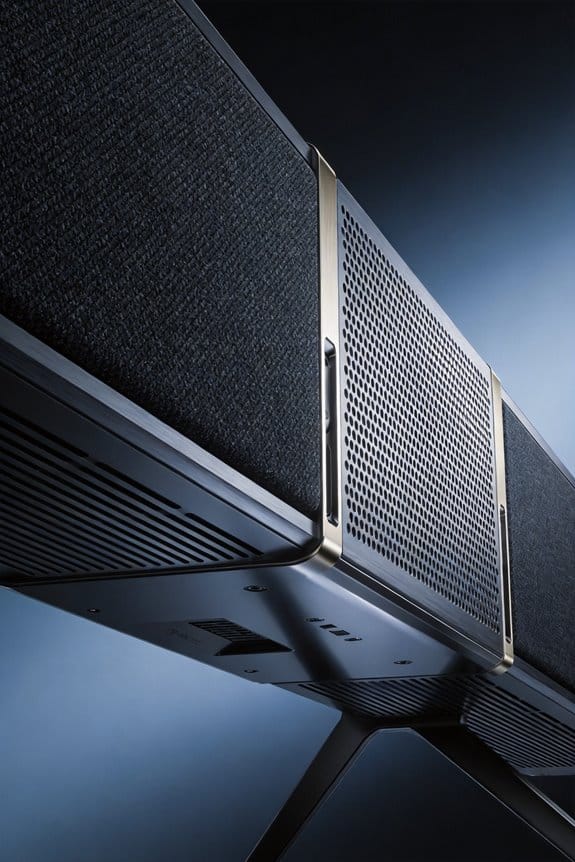
Have you ever been at a movie or concert and thought, “Wow, it feels like the sound is coming from everywhere”? That’s the magic of sound virtualization in action, and it’s a game-changer for how we enjoy audio at home without cramming speakers all over the place.
So, how does this work? Soundbars can create that immersive experience without needing a ton of speakers. They do this by sending different audio signals from each driver at just the right moment, tricking your brain into thinking sounds are coming from various spots—even if there aren’t actual speakers in those places. A soundbar with four drivers can give you way better surround sound than one with just two. But here’s the catch: most soundbars, even the good ones with five or fewer drivers, depend heavily on this technology to pull off that impressive sound effect.
Here’s the trick: these systems take advantage of your brain’s ability to understand where sounds come from. By manipulating the sound, they create a sense of space that can’t be ignored. It makes your audio experience feel like it’s filling the entire room rather than just blasting from a few nearby speakers.
And it gets even better. With modern System-on-Chip (SoC) processors, these virtualization algorithms are built right into the hardware. This not only makes the soundbars easier to develop but also improves the audio quality you get straight out of the box. So, you’re ending up with realistic spatial audio without needing an expensive setup involving multiple speakers scattered throughout your space.
Truth is, if you want to enhance your home audio experience without the hassle of a big speaker setup, consider a soundbar that uses virtualization technology. It’s a smart approach that gives you great sound without the clutter. How cool is that?
Why Your Soundbar Adjusts to How Human Ears Actually Hear
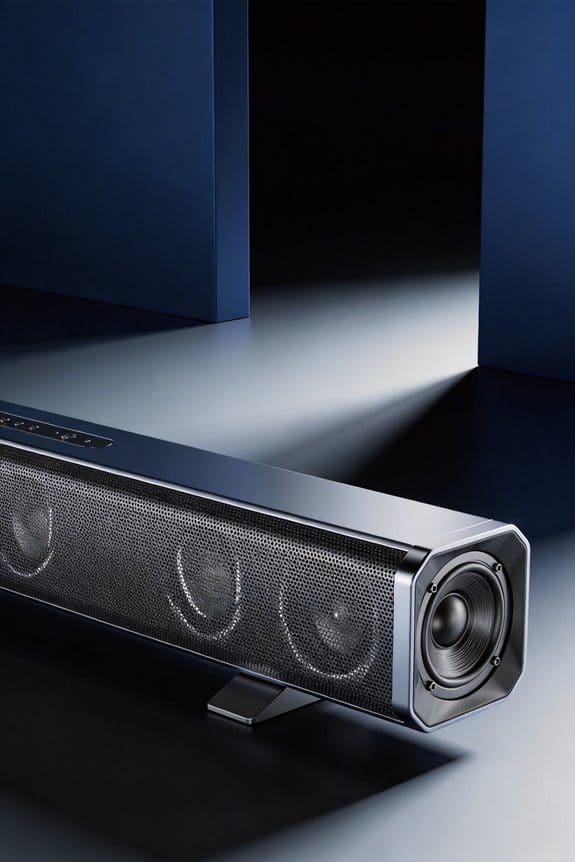
Ever notice how music sounds different at low volume versus blasting it? That’s not just your imagination; your soundbar’s got a little science working behind the scenes to help you hear everything just right.
Your ears process bass and treble in unique ways, depending on how loud the audio is. Sound engineers take this into account, using Fletcher-Munson curves, which adjust frequencies to keep everything balanced. This means you can enjoy a movie or tune in quietly at night without missing any details.
The cool part? Your soundbar tackles those pesky auditory illusions caused by your living space. Did you know mid-range frequencies might seem louder than bass, even when the decibels are the same? That’s why modern soundbars apply logarithmic principles to audio, making small tweaks in the mid-range where your ears are most sensitive, giving you great sound no matter what you’re listening to.
So, why does this matter? When you sit down for movie night or a jam session, the careful engineering of your soundbar creates a listening experience that feels natural and immersive. You won’t catch every detail if the audio isn’t balanced just right.
In short, soundbars are designed to cater to your ears, making everything clear whether you’re cranking up the volume or keeping it mellow. Next time you hit play, think about how your space and volume are working together to create the audio experience you enjoy! What soundbar trick have you tried to elevate your listening?
Up-Firing Drivers and Ceiling Reflections: Creating Height Without Atmos Speakers
Have you ever wanted that immersive surround sound experience without the hassle of installing speakers all over your living room? Up-firing drivers in modern soundbars might just be the answer you’re looking for. Instead of needing to mount speakers high on walls or invest in costly stands, these clever drivers use your ceiling to reflect sound, creating an overhead audio effect.
These drivers angle upwards at about 45 degrees, bouncing sound off your ceiling to simulate that height perception you’d typically get from dedicated speakers. When the audio reflections travel from the soundbar, hit the ceiling, and then come down to your listening spot, it feels like sound is coming from above. Pretty cool, right?
Dolby Atmos soundbars make great use of this technique, delivering an engaging listening experience thanks to their ability for object-based sound panning. However, for the best results, you’ll want to have a ceiling height between 7 and 12 feet. If your ceilings are too low or too high, you might not get the full effect. So, why does this matter? The way your brain interprets these reflected sounds can turn a flat audio system into something that feels three-dimensional.
Here’s the trick: make sure your room is set up just right for this. Think about your ceiling height and the kind of room where you’ll use the soundbar. You want to maximize that height perception, and having the right setup helps a lot.
Smart Volume Control and Dialogue Clarity Through Psychoacoustic Design
Have you ever found yourself straining to catch every word during those quiet moments in movies, only to be jolted back to reality by a loud explosion? It’s frustrating, right? Luckily, smart volume control technology is here to help tackle this common issue.
Modern soundbars come packed with smart algorithms designed to analyze audio signals as they play. They do the heavy lifting by automatically compressing the dynamic range of sound. This means those soft whispers stay clear while the booming action scenes won’t make your heart race for the remote. It’s a practical solution that makes a big difference during movie nights.
What’s interesting is how these systems use something called Fletcher-Munson equal loudness curves to understand how we hear different sounds at various volumes. You may not think about it much, but our ears pick up on certain frequencies better than others. That’s why soundbars enhance mid-range frequencies, where human speech usually hangs out, around 300 Hz to 3,000 Hz.
So, if you watch everything from news broadcasts to movies and even commercials, you’ll enjoy a consistent sound level without the constant need to adjust the volume yourself. Honestly, who wants to deal with that hassle over and over again?
In short, smart volume control is all about making your viewing experience smoother. Next time you sit down for a movie, notice how much easier it is to follow the dialogue without cranking up the volume too high. Isn’t it time to enjoy your films without the audio rollercoaster?
Why Modern Soundbars Sound Better Without Costing More
Have you noticed how much better modern soundbars sound compared to older models, even when they cost about the same? It’s all thanks to some really cool advancements in sound technology.
Modern soundbars are designed with smart virtualization algorithms that make them sound like they have a wide soundfield, despite having fewer drivers. You’ll find today’s soundbars often pack psychoacoustic processing right into their chips. This means they can deliver that impressive audio experience using fewer components, which also helps keep costs down. Those four-driver systems can now create surround sound effects that once needed more than eight speakers. Isn’t that wild?
When it comes to the technology behind the drivers, manufacturers have been clever about where they place them. They’ve paid close attention to how humans hear, which improves the 3D sound experience without needing extra gear. For instance, if you love Dolby Atmos, you can enjoy that cinematic sound with up-firing speakers that bounce audio off your ceiling, giving you that extra height without drilling any holes. Plus, using Fletcher-Munson curves helps ensure that your sound stays balanced at all volume levels. That means you get solid performance whether you’re cranking up your favorite action movie or just enjoying some background tunes.
So, why does this matter for you? It lets you enjoy high-quality audio without needing to break the bank.
In short, if you’re looking for great sound without the hassle, modern soundbars really do pack a punch. Have you thought about upgrading your sound system lately?
Loudness, Tonality, and Sharpness: Metrics That Reveal True Sound Quality
When you’re looking to buy a soundbar, you may find it frustrating trying to figure out what’s really affecting sound quality. Ever wonder why some soundbars sound amazing while others fall flat? It all boils down to three important metrics: loudness, tonality, and sharpness.
Loudness perception plays a big role in how we hear volume levels across different frequencies. It’s how our ears interpret sounds, which is crucial for engineers when they’re fine-tuning frequency response based on something called Fletcher-Munson equal loudness contours. If you’re not familiar with that, it’s just a fancy way of describing how certain sounds can seem louder than others at different pitches.
Tonality balance is another key player here. It looks at the relationship between tonal and non-tonal sounds in what you’re listening to. This ensures that the music or background effects don’t drown out important dialogue—because honestly, there’s nothing worse than missing a key plot point because the sound mix is off.
And then there’s sharpness. This measures how intense the high-frequency content is, which influences whether speech sounds clear or abrasive. You definitely want that crisp sound for dialog without it feeling harsh on your ears.
How do you get a handle on these metrics? You might want to check out tools like Sorama’s CAM64 acoustic camera with their Portal software. It can show you some cool data about critical bands and spectrum analysis. Plus, it tracks changes in these metrics as scenes evolve, helping you pinpoint moments that need better audio handling.
Frequently Asked Questions
Can Psychoacoustic Soundbars Work Effectively in Rooms With Low Ceilings?
Yes, they’ll work in your low-ceiling room. The closer ceiling reflections actually enhance up-firing speakers’ height effects. However, I’d recommend minimal acoustic treatment on your ceiling to preserve those reflections for ideal Atmos virtualization.
Do Psychoacoustic Features Drain More Power Than Traditional Soundbar Designs?
I’d say psychoacoustic features don’t inherently drain more power. They’re actually software-based processing tricks. The power efficiency mainly depends on driver count and amplification. You’ll get enhanced sound quality without notably higher energy consumption compared to traditional designs.
Can Hearing Loss Affect How Well Psychoacoustic Virtualization Works?
Yes, hearing loss can greatly impact psychoacoustic virtualization effectiveness. I’ve found that reduced hearing sensitivity alters sound perception, making it harder for your brain to interpret the spatial cues and directional information that virtualization relies upon to create immersive audio.
Are Psychoacoustic Soundbars Compatible With Older TV Models and Connections?
I’d say most psychoacoustic soundbars work fine with older TVs through standard connection types like optical or HDMI ARC. You might encounter minor compatibility issues with very old models, but basic surround virtualization features typically function well regardless.
How Does Room Size Impact Psychoacoustic Surround Sound Performance?
Surprisingly, I’ve found room size dramatically affects performance. Larger spaces weaken acoustic reflections needed for height effects, while smaller rooms enhance sound dispersion. You’ll get ideal psychoacoustic virtualization in medium-sized rooms where ceiling-bounced audio works best.