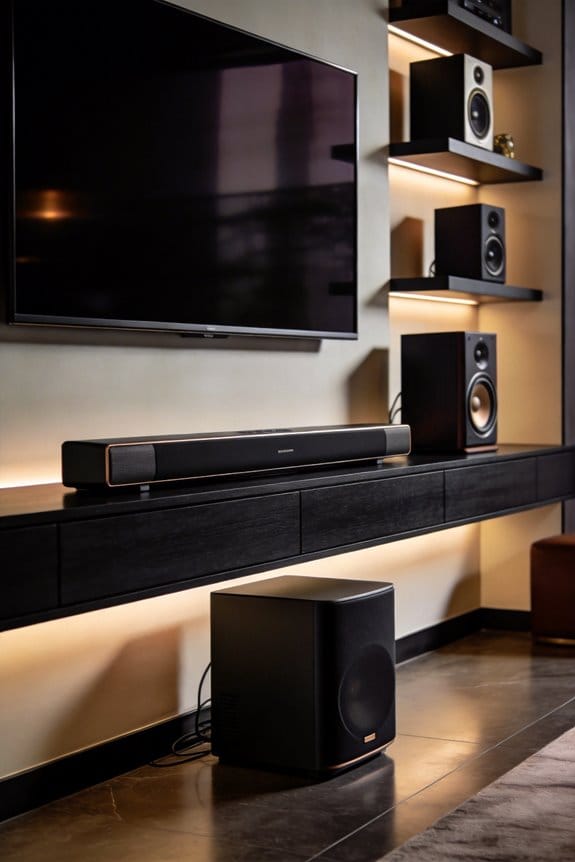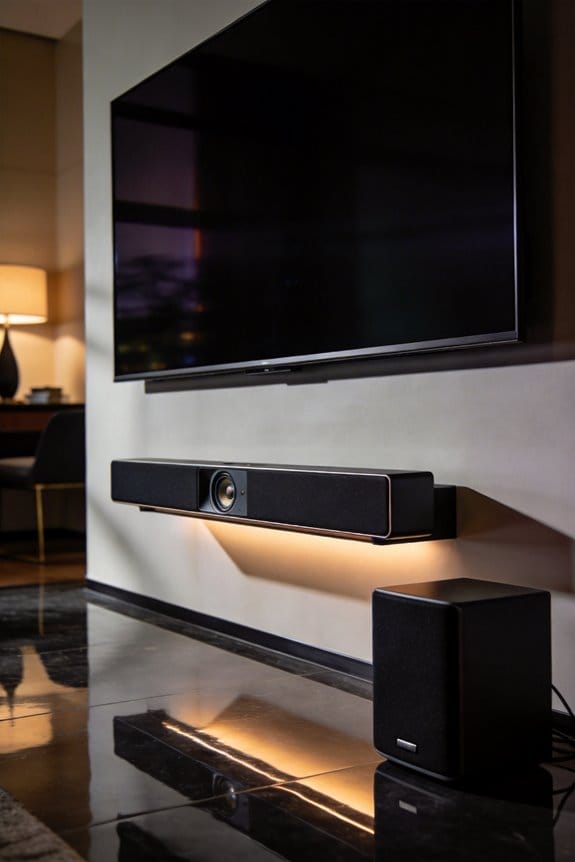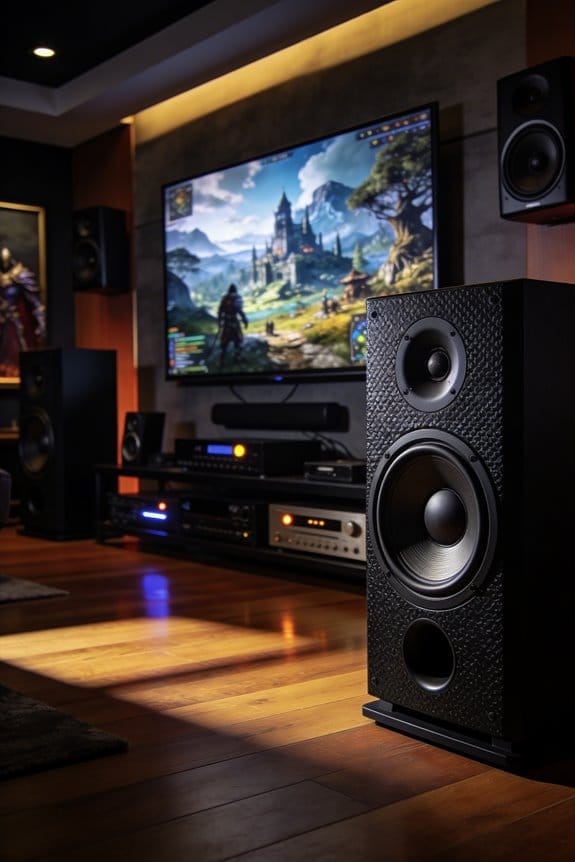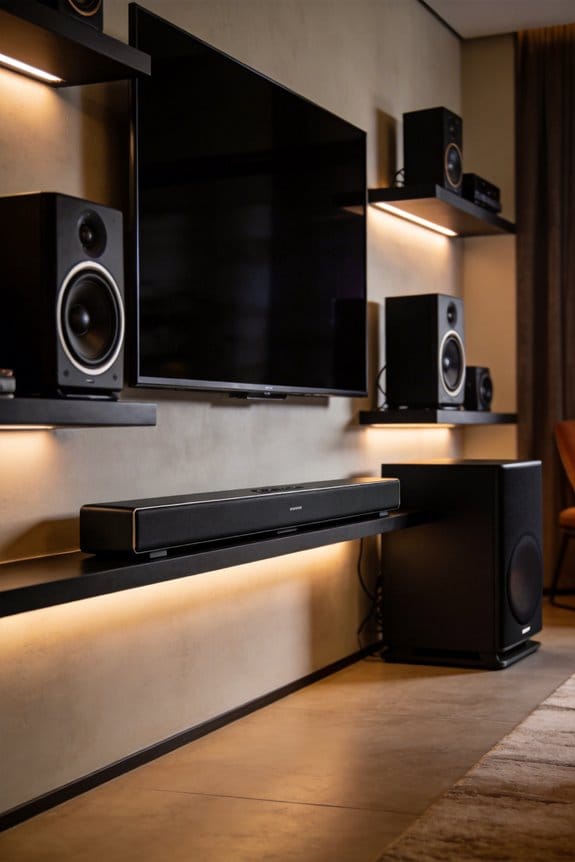
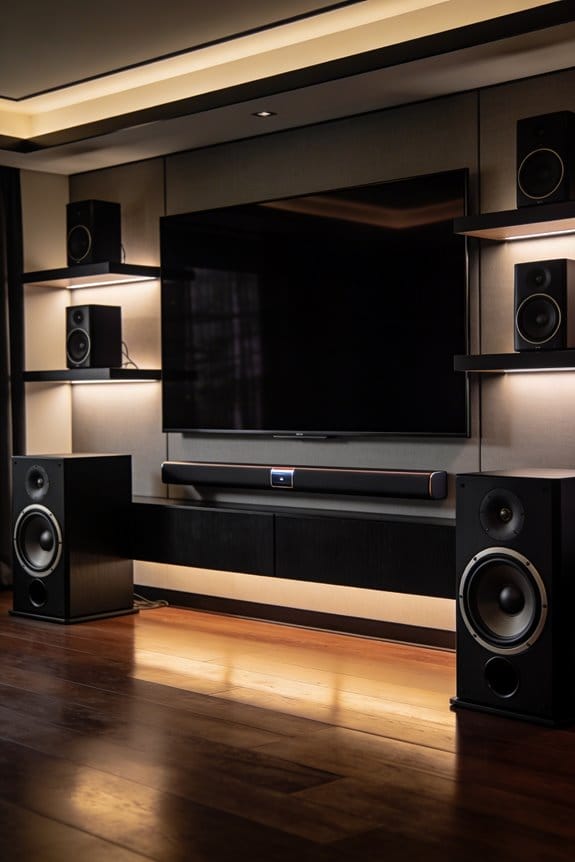

I’ll explain why dual subwoofers solve bass problems in large rooms by addressing standing waves, which create volume variations up to 12dB between different listening positions. When you use two subs instead of one, you’re distributing bass energy from multiple locations, and this smooths out the peaks and valleys that cause boomy spots and dead zones. Each subwoofer excites different room modes, so the overlapping sound waves fill in gaps where a single sub creates nulls. The sections below cover ideal placement strategies, distortion reduction benefits, and techniques for achieving omnipresent bass coverage.
Key Takeaways
- Dual subwoofers distribute bass more evenly, reducing standing wave interference that creates boomy spots and dead zones in large rooms.
- Two strategically placed subs smooth out frequency response variations, improving bass consistency from ±12dB across different listening positions.
- Spreading subs apart prevents single-point bass concentration, allowing sound waves to blend and fill gaps in room coverage.
- Dual subs work better with auto-calibration systems to compensate for room acoustics and eliminate problematic frequency nulls.
- Multiple bass sources create overlapping low frequencies that minimize location-specific cancellations common in larger spaces.
Why Your Room Has Boomy Spots and Dead Zones?
When you’re cranking up some bass-heavy music at home, have you ever noticed that it sounds totally different in different parts of the room? That’s because sound waves aren’t just traveling straight to your ears; they bounce around off walls, floors, and ceilings. These bouncing waves create reflections that mess with the original sound, resulting in some interesting—and sometimes frustrating—acoustic quirks.
Here’s the deal: when sound waves reflect back and forth between parallel surfaces, you get this phenomenon known as standing waves. In certain spots of your room, the waves come together and make the bass sound way too loud, creating boomy spots. But in other areas, those same waves can cancel each other out, leaving you with weak or missing bass—what we call dead zones. This whole situation really depends on your room’s acoustics, and smaller spaces tend to have even more drastic issues. If you’ve got a single subwoofer, that’s just gonna amplify the peaks and valleys in sound at different places where you listen.
So, why does this matter? Well, if you want to enjoy your music (or movies) the way they’re meant to be heard, you’ll need to think about your space a little more. Here’s a trick: try moving your seating or speakers around to find those sweet spots where the bass sounds just right.
It’s all about trial and error. Don’t get discouraged if you don’t get it perfect on the first try. You’ll likely have to experiment a bit to find the right configuration. Just remember that every room has its own character when it comes to sound.
How Dual Subwoofers Smooth Out Bass Throughout the Room

Are you tired of fighting with bass in your space? You know those spots where the bass just doesn’t hit right, or it booms too much instead? Adding a second subwoofer can really make a difference. By positioning dual subs around your room, you create overlapping sound waves that help fill in the gaps that a single sub often leaves behind.
So, what happens when you add that second sub?
- It minimizes those peaks and dips caused by standing waves, evening things out.
- You’ll get a more consistent bass experience no matter where you’re sitting.
- Research shows that with just one sub, you might see bass response variations of up to ±12dB, but dual setups can significantly improve that response, especially below 45Hz.
- Plus, if you use an auto-calibration system like Audyssey MultEQ, it’ll do a better job with two subs than just one.
The trick is to place those subs strategically at different edges of the room, rather than clustering them together. Think about it: would you rather have one loud spot or smooth bass spread throughout?
In the end, whether you’re hosting movie nights or just relaxing with your favorite tunes, dual subwoofers can make a noticeable difference. Have you thought about where you’d place them?
Why Two Subs Give You Cleaner, Louder Bass Without Distortion

What’s the deal with adding more bass to your sound system? Some folks might think it’s unnecessary, but trust me, having dual subwoofers can really enhance your audio experience. Here’s the scoop: when you have two subs, they split the work. Instead of one driver doing all the heavy lifting, each one handles half the workload. This helps lower distortion and compression, meaning you get cleaner bass without any strain on your speakers.
Think about it—if you’re cranking up the volume, dual woofers give you up to 6dB more headroom, especially in corner-loaded setups. This translates to louder sounds without clipping, which can make all the difference when you’re watching an action scene. Nothing’s worse than drowning in distortion during those epic moments in a movie.
If you’ve invested in high-powered subwoofers rated at 2800W or more, you really should consider going with two. These powerful units shine in larger rooms, where they can do their thing without breaking a sweat. Here’s the trick: when you reduce the output demand on each sub, you keep the dynamic range intact, even during intense audio moments. This means you won’t end up with that muddy, strained sound that often comes from a single sub working overtime.
Frankly, it’s about controlling the chaos. Two subs help keep everything balanced and crisp, especially at louder volumes. So, if you’re serious about your sound system, think about adding that second subwoofer.
Where to Position Dual Subwoofers for Even Coverage?
Positioning your dual subwoofers just right can make a huge difference in how your bass sounds. If you’re tired of that muddy sound that makes it hard to enjoy your music or movies, here’s a tip: try placing one sub at the front of the room and the other on a side or rear wall. This way, you’ll get better coverage and a smoother bass response across the whole area, rather than just a punchy spot in the center.
Want to know where to start? Avoid putting both subs in the same spot; that can create uneven audio with reflections and dead spots that just don’t sound good. Instead, think about your room’s dimensions. Measuring it can help you find those sweet quarter-wavelength spots that help equalize the sound. You’ll want to keep both subs at least 4 feet apart to allow their sound waves to blend better.
Not sure about the best setup? Play around with the positioning of one sub while the other stays put. Grab a measurement microphone and listen to the frequency response from your main spot. Adjust until you get a nice, even response with minimal peaks and nulls, especially below 80Hz. So, why does this matter? Well, a little effort in positioning can lead to a significantly more enjoyable listening experience.
To wrap it up, make sure to space your dual subs and avoid clustering them together. With some experimentation, you might just discover a setup that transforms your audio experience. What’s your current bass setup like, and have you noticed any issues with it?
Why Dual Subs Make Bass Feel Like It’s Everywhere at Once
Once you’ve got your dual subs set up right, you’re in for a treat with the way bass fills your space. It’s pretty wild how low frequencies suddenly seem to come from all around you, rather than just one corner of the room. Instead of pinpointing bass to a specific spot, it feels like the sound is wrapping around you, creating an immersive experience that’s tough to beat.
So, why does this matter? Well, it all boils down to how your brain processes sound. When multiple subs are kicking out overlapping low frequencies—typically below 80Hz—your brain struggles to figure out where it’s coming from. The sound waves blend together, bouncing off walls and filling in those dead zones you might have in your room. This means you can’t easily tell which sub to blame for the vibrations, and that eliminates those directional cues that normally tell you where the bass is coming from.
Here’s the trick: when the bass feels like it’s coming from all around, it becomes a seamless part of your audio experience. You’ll notice that explosions, music, and sound effects share a more natural, three-dimensional quality that makes everything come alive.
Honestly, the best part is that this setup makes your main speakers sound better, too. There’s a cohesive feel to the audio that can really enhance your enjoyment. It’s surprising how much better bass can be when it’s not tied down to a single location.
In the end, positioning dual subs correctly can transform your listening experience. What do you think would happen when you immerse yourself in sound that feels like it’s everywhere? Give it a try!
Frequently Asked Questions
Do I Need Matching Subwoofers or Can I Mix Different Brands?
Don’t let perfect be the enemy of good—I’d say you can mix brands if they’ve got matching performance specs like output and frequency response. However, subwoofer compatibility matters most for seamless calibration and consistent bass coverage.
What’s the Minimum Room Size That Benefits From Dual Subwoofers?
I’d say any room over 150 square feet benefits from dual subwoofers. There aren’t ideal dimensions—it’s about room acoustics. Even smaller spaces suffer from standing waves, but you’ll notice the most improvement in larger areas.
Can I Use Dual Subs in an Asymmetric or L-Shaped Room?
Yes, I’d actually recommend it! L-shaped rooms benefit greatly from asymmetric placement since irregular room acoustics already reduce symmetrical reflections. Place subs at opposite boundaries to combat remaining modal issues and achieve smoother bass coverage.
How Much Does Adding a Second Subwoofer Typically Cost Overall?
I’d budget $300-$2000+ for a matching second subwoofer, depending on your model. Installation expenses are usually minimal—just another power cable and audio connection—unless you’re hiring professionals for custom placement and calibration work.
Will Dual Subwoofers Work With My Existing Receiver’s Auto-Calibration System?
Yes, I’ve found most receivers handle dual subwoofers through their auto calibration features. Systems like Audyssey MultEQ actually work better with dual setups, making subwoofer integration easier since they’ll automatically balance levels and timing between both units.