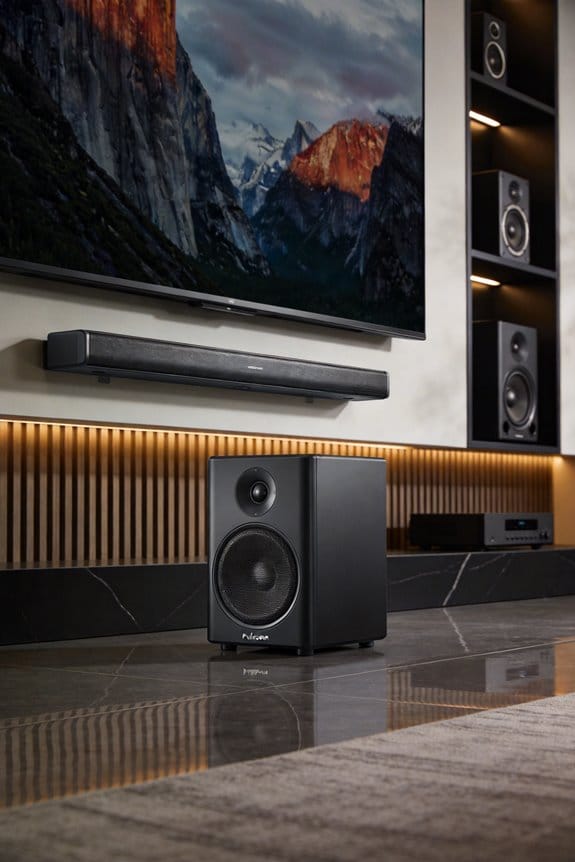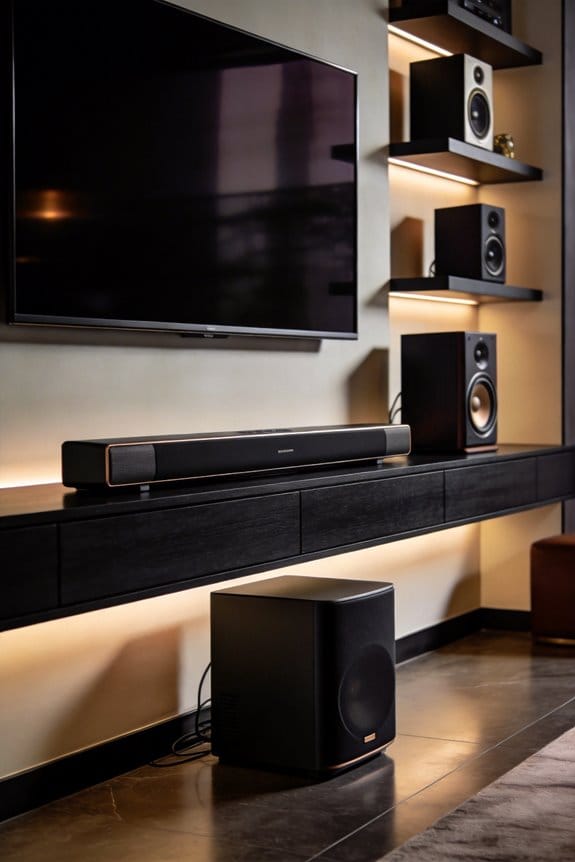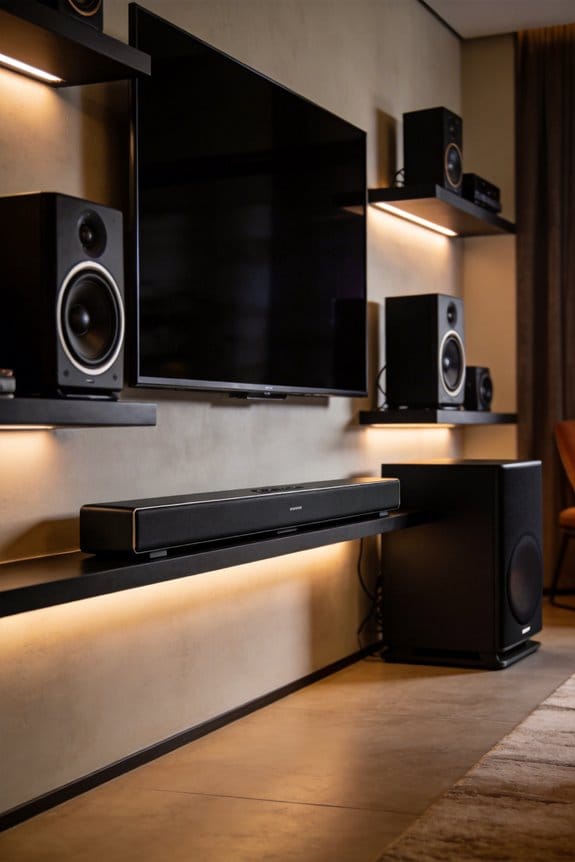
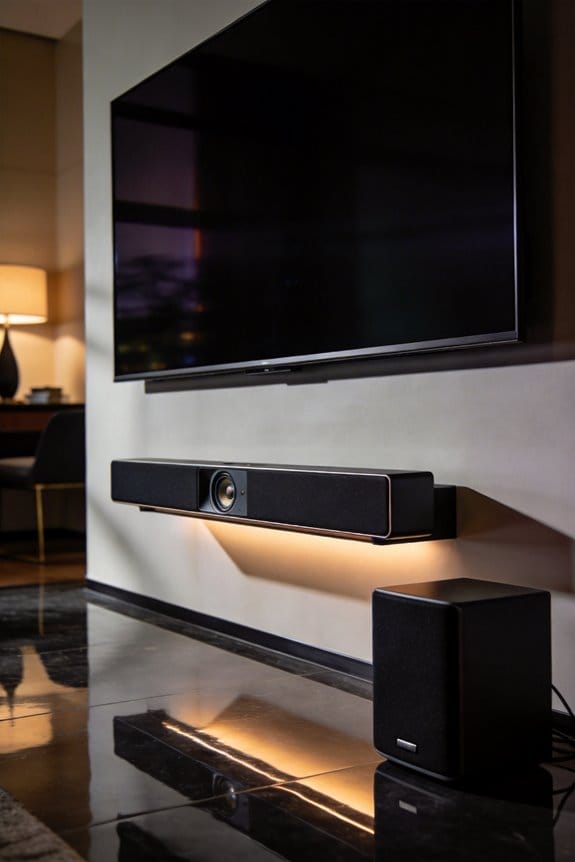

I’ve watched ultra-slim soundbars under 6 cm transform home audio through miniaturized driver engineering, particularly Sound Motion woofer technology that compresses traditional 12 cm speaker components into 4 cm profiles. These advanced woofers use unique membrane shapes and motor configurations to deliver bass frequencies between 60-120 Hz, effectively doubling bass output while occupying minimal space. Models like Samsung’s HW-S800D at 1.6 inches tall and Sonos Arc Ultra incorporate these innovations with Dolby Atmos support, creating immersive three-dimensional sound without bulky cabinets that obstruct your TV’s interface elements.
Key Takeaways
- Ultra-slim soundbars under 6 cm address modern minimalist setups, preventing subtitle obstruction while meeting growing demand for space-saving audio solutions.
- Sound Motion woofer technology doubles bass output using unique membrane shapes and motors, delivering powerful low-end without bulky cabinets.
- Miniaturized drivers with advanced DSP tuning optimize sound performance in compact designs, competing with larger systems in audio quality.
- Dolby Atmos integration enables three-dimensional audio experiences through upward-facing speakers and object-based sound positioning in slim profiles.
- Leading models like Samsung HW-S800D and Sonos Arc Ultra demonstrate successful engineering of powerful audio in sub-6-cm designs.
Why Ultra-Slim Soundbars Under 6cm Are Replacing Traditional Models in 2026

Are you tired of soundbars that block your TV screen? You’re not alone. As TVs get thinner and feature more minimalist designs, traditional soundbars that stand 8 to 12 cm tall can really ruin your viewing experience. That’s why we’re seeing a rise in ultra-slim soundbars under 6 cm.
People are looking for ways to keep their entertainment setups sleek and clean. You want something that fits neatly under your TV without getting in the way of subtitles, channel indicators, or those important streaming interface elements.
For example, take Samsung’s HW-S800D. It’s got a cool profile of just 1.6 inches (4.06 cm) thanks to its mini driver arrays. Plus, European brands are stepping up with their own models that are perfect for wall-mounted setups. It’s all about matching that contemporary look that’s so popular in urban homes these days.
So, why does this matter? Since most urban living spaces are tight, having a compact sound solution means you can have a cable-free setup that preserves your visual flow. And if you’re partnering a soundbar with a 55-inch or larger QLED or OLED TV, it’s a game of eliminating those annoying obstructions caused by thicker models.
The best part is that slimmer soundbars can still deliver impressive sound quality without taking up too much space. So, whether you’re binge-watching your favorite show or enjoying movie night, your experience won’t be spoiled by bulky equipment.
How Sound Motion Woofers Deliver Double the Bass in Half the Space

Are you struggling to find the perfect soundbar that doesn’t take up too much space but still delivers powerful bass? You’re not alone. Traditional woofers usually require big cabinets to produce deep bass, which just doesn’t fit with the sleek designs we all want these days.
Check out Sonos and their Sound Motion woofer technology. This innovative approach manages to pack double the bass into half the volume of conventional designs. How do they pull this off? By using a unique membrane shape and a different motor setup than the usual cone drivers. The result? The Arc Ultra stays under 6 cm tall without skimping on sound quality, especially in that sweet 60-120 Hz range.
You might be wondering how they handle the physics of sound with less air movement. Well, the answer lies in advanced DSP tuning that compensates for that, creating a punchier low-end response. So, if you’re looking to integrate powerful bass into your minimalist setup, this technology makes it possible without cramping your style.
The best part is that you don’t have to sacrifice sound for looks anymore. It’s a win-win situation that meets the needs of modern consumers. Frankly, if you’re after a sleek design but still want to feel the thump of your music or movies, consider giving the Sound Motion woofers a shot.
Samsung HW-S800D vs. Sonos Arc Ultra: Comparing Top Ultra-Slim Models

When picking between the Samsung HW-S800D and the Sonos Arc Ultra, you might feel a bit overwhelmed since both are ultra-slim soundbars with their unique strengths. It’s like two stylish contenders stepping into the ring, but each one brings a different flair to the audio game.
Profile Dimensions
Let’s talk about size. The Samsung HW-S800D stands at just 1.6 inches tall. That’s incredibly slim, making it a great choice if you’re tight on space. The Sonos Arc Ultra is a bit thicker but still hangs in there with a low-profile design that won’t block your TV screen. So, if you’re worried about visual clutter, both options will fit nicely in your home without overwhelming your setup.
Features Comparison
Now, what’s under the hood? Samsung’s got Neo QLED pairing technology, giving you some slick, synchronized audio and visual experience. On the flip side, Sonos is all about that double bass action, thanks to its Sound Motion woofers which pack a punch in a compact design. Both models support Dolby Atmos, which means you’re in for an immersive audio experience, and they’re both wireless. Nobody wants those pesky cables, right?
Market Trends
So, what’s the buzz in the market? Samsung holds a nice chunk of the wireless share at 28.8%. Why? They combine sleek looks with smart TV features, tapping into what many folks want: a minimalist home theater setup that doesn’t take up too much space. Honestly, it’s an attractive proposition for anyone looking to enhance their viewing experience without a cluttered setup.
In the end, both the Samsung HW-S800D and Sonos Arc Ultra bring something to the table. Think about what matters most to you—thinner design, specific audio tech, or smart features. Which one do you think fits your style better?
Wall-Mount vs. Tabletop: Which Slim Soundbar Setup Fits Your Room?
Have you ever noticed how sound can sometimes feel out of sync with what you’re watching on your TV? That disconnect can really ruin your viewing experience. If you’re contemplating whether to mount your soundbar on the wall or go for a tabletop setup, you’re in the right place.
Let’s dive into the benefits of wall-mounting your soundbar:
- It allows for direct audio alignment with your TV, which can significantly reduce that frustrating sound-image disconnect.
- If you’re working with a smaller room, like one under 150 square feet, mounting saves valuable space on your media console.
- Positioning it 6-8 inches below the center of your TV can enhance those Dolby Atmos effects, making the sound feel larger than life.
- Plus, cable management can be cleaner when you route through in-wall conduits, giving your setup a tidy look.
On the flip side, there are some great reasons to consider a tabletop placement:
- If you ever want to change the room layout, it’s way easier to relocate a soundbar that isn’t bolted to the wall.
- Renting? No drilling means no damage to your walls, which is a big plus.
- When placed on solid wood surfaces, soundbars can couple better with low frequencies, giving you richer sound.
- Setting it up is usually a breeze since they come with rubber feet that make placement simple.
If you’re leaning toward a wall mount, you’ll need universal brackets that are rated for 10-15 pounds. Interestingly, tabletop setups still take the lead in market share at around 59-62%, but wall-mounted models are slowly growing, showing about a 9.18% annual growth. That’s thanks, in part, to the slim profiles under 6 cm that allow for discreet mounting.
How Dolby Atmos and AI DSP Create 3D Audio in Compact Soundbars
Ever feel like your movie nights at home just don’t give you that big-screen excitement? You’re not alone! The good news is that even compact soundbars, which are under 6 cm tall, can now create a three-dimensional audio experience that can rival a theater. It’s pretty cool how technology has come together to pull this off.
So, how does it work? The magic starts with Dolby Atmos. Instead of thinking in traditional sound channels, it treats sound as objects in space. This means you can hear effects coming from all around you—infront, to the side, and even directly above. Imagine hearing a helicopter or the sound of rain dropping, and feeling like it’s right over your head. That’s made possible because the sound system sends height information to speakers that point upwards and bounce sound off the ceiling.
Now, what about those annoying echoes and uneven sounds that can ruin the experience? This is where AI-driven digital signal processing (DSP) steps in. It constantly analyzes your room—how sound interacts with walls and furniture—and makes real-time adjustments. This means less of that muddled sound you might be used to with regular setups and more of an immersive feel.
Here’s the trick: some soundbars even take regular stereo sounds and enhance them using smart programming, creating a wider sound experience that feels fuller than the physical size of the bar. So, if you’re thinking a compact design can’t deliver, think again!
The best part is that setting this up in your home is simplified. With these advanced features, you can truly feel like you’re in a live concert or a thrilling movie scene without needing a huge sound system.
To sum it up, compact soundbars are changing how we enjoy audio at home. Isn’t it exciting how technology can transform a simple movie night into an experience? What’s stopping you from upgrading your home audio setup?
Frequently Asked Questions
What Materials Make Ultra-Slim Soundbars More Sustainable Than Traditional Speakers?
Unlike bulky traditional speakers that pile up in landfills, I’ve seen ultra-slim soundbars embrace recycled components like aluminum and biodegradable materials in packaging. Their energy-efficient chips and modular designs let you upgrade parts, drastically cutting electronic waste.
Can Modular Soundbar Designs Reduce Long-Term Ownership Costs Through Upgrades?
Yes, I believe modular upgrades greatly improve cost efficiency by letting you replace individual components—like drivers or DSP chips—instead of buying entire systems. You’ll extend your soundbar’s lifespan while avoiding the premium pricing of complete replacements.
How Do DSP Chip Shortages Affect Ultra-Slim Soundbar Availability?
DSP chip impacts directly limit production volumes, forcing manufacturers to prioritize flagship models over entry-level bars. I’ve seen supply constraints delay launches by quarters, push retail prices up 15–20%, and shrink your selection of ultra-slim options considerably.
Which European Boutique Brands Specialize in Sub-6 Cm Soundbar Models?
I don’t have specific brand names from the knowledge provided, but European craftsmanship drives boutique innovation in sub-6 cm models for discreet setups. I’d recommend researching specialized audio manufacturers in Germany, Denmark, and the UK for these ultra-slim designs.
Do Ultra-Slim Soundbars Work With Older Non-Smart TV Models?
Yes, I can confirm ultra-slim soundbars work with older non-smart TVs through optical or analog connections, though you’ll face compatibility concerns. However, audio performance remains solid since these models don’t rely on smart features for sound quality.