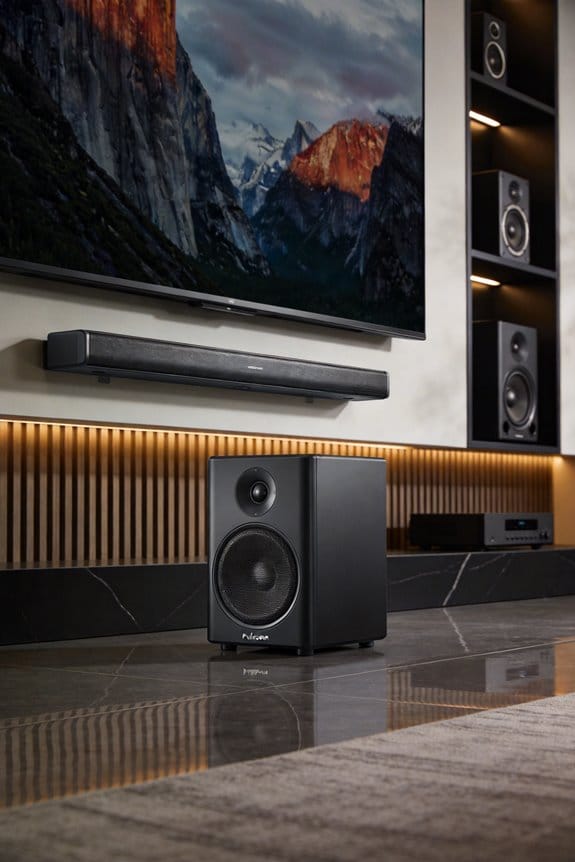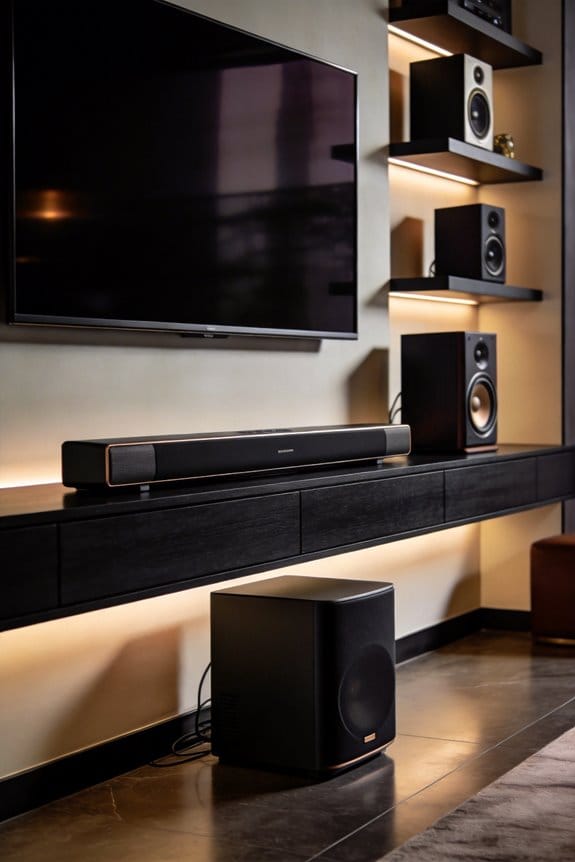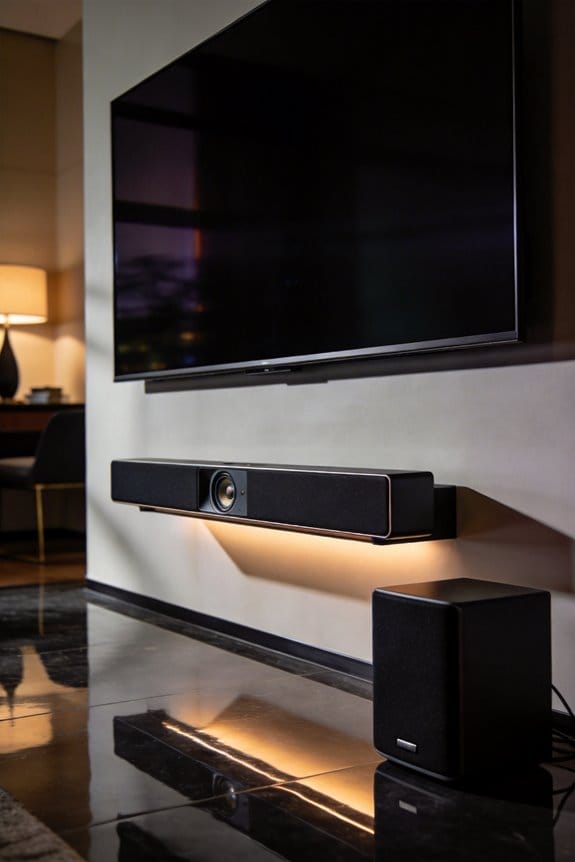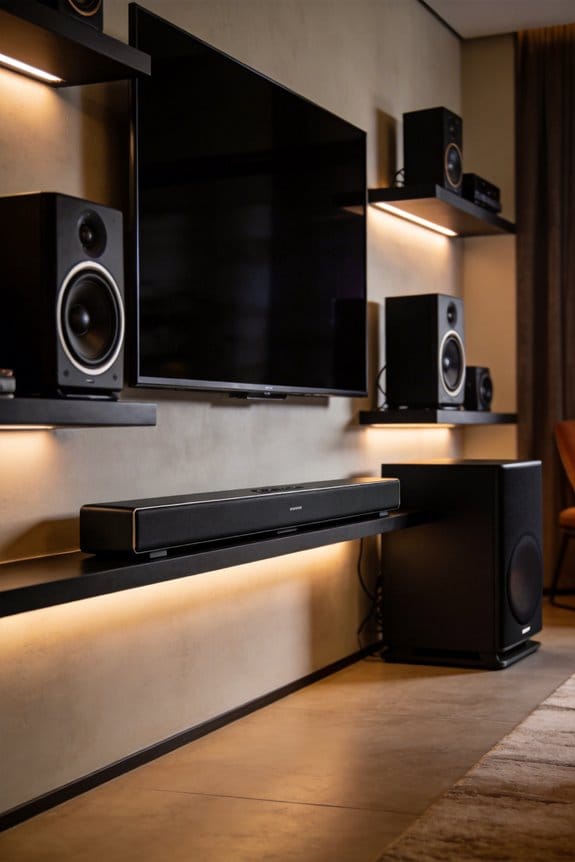
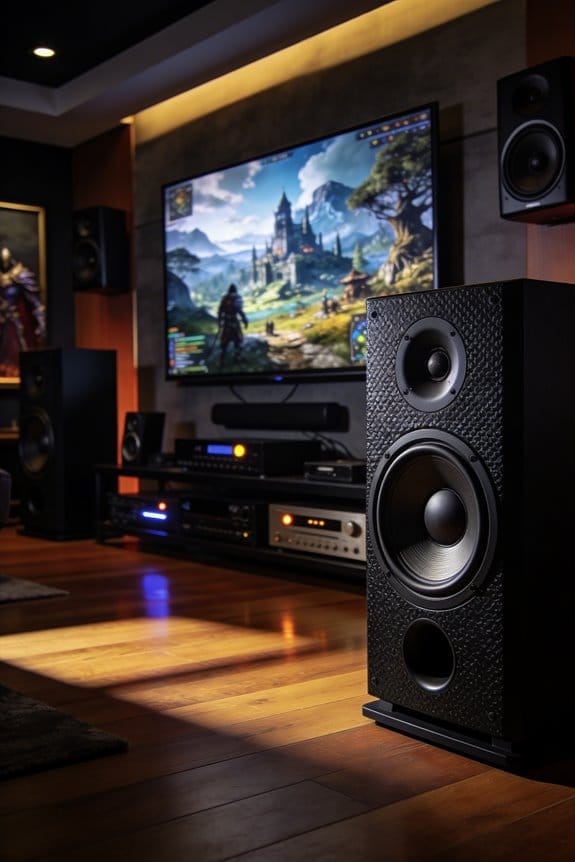

A subwoofer handles low frequencies between 20-80 Hz, which creates physical sensations that make open-world RPG environments feel present rather than just audible. I’ve found it adds depth to thunder rumbles, footstep impacts, and ambient environmental sounds while allowing your main speakers to focus on dialogue and music. Proper placement, typically 12-18 inches from front corners, and calibration through auto-setup features guarantee the bass blends seamlessly with surround channels instead of overpowering them. The sections below cover specific placement techniques, frequency tuning methods, and multi-subwoofer configurations for larger spaces.
Key Takeaways
- Subwoofers handle low frequencies (20-80 Hz), creating physical sensations that enhance immersive environments like ancient ruins and forests in RPGs.
- Deep bass adds realism to thunder, footsteps, and ambient sounds, making open-world scenes feel more alive and emotionally engaging.
- Proper subwoofer placement (12-18 inches from corners) and calibration ensure balanced, clear bass without overwhelming dialogue or environmental sounds.
- Multi-subwoofer setups eliminate dead spots and provide consistent bass response across larger rooms, improving overall audio immersion.
- Quality subwoofer configuration allows main speakers to focus on dialogue and music, maintaining clarity during intense gameplay moments.
What a Subwoofer Actually Adds to Open-World RPG Audio
Ever notice how some subwoofers just seem to pull you right into a game? It’s like when a massive wind gust flings dust around or a magical explosion shakes the ground; those low rumbles add so much realism. The tricky part is that without a quality subwoofer, you might miss out on that immersive experience. If you’ve got a powerful subwoofer, it takes care of all those deep, demanding sounds, while your main speakers focus on what you actually want to hear—like dialogue and music.
So, what does that mean for your gaming experience? Think about it this way: it helps keep everything clear. You’re not left scrambling to hear that important conversation while an earthquake rumbles in the background. Instead, each sound layer stays crisp and recognizable, even during intense gameplay moments.
Try this: when you’re in a game, pay attention to how the sound shifts. Notice how the wind, the crunch of a footstep, or the swoosh of a spell cast all play their part? A good subwoofer enhances that dynamic, ensuring every element shines through without muddiness. It’s definitely worth considering if you want to take your gaming audio to another level.
Honestly, it’s those subtle details that make all the difference in an open-world RPG. You want to feel like you’re really there, right? A subwoofer helps bridge that gap, making the soundscape feel alive.
In short, investing in a good subwoofer can dramatically improve your gaming sessions. Why not give it a shot and see for yourself?
How Thunder, Footsteps, and Ambient Rumble Change With a Subwoofer
Have you ever noticed how some sound effects just don’t pack the punch they should? If you’re a gamer or even a casual movie watcher, adding a subwoofer to your setup can really elevate your experience.
Take thunder, for instance. When you experience thunder from a standard speaker, it often sounds flat and unimpressive. But with a subwoofer, those low frequencies between 20 and 80 Hz come to life, providing a deep rumble that you just can’t replicate with regular speakers. Suddenly, when lightning strikes on screen, you feel that atmospheric pressure change—not just hear it.
Now, let’s talk about footsteps. If you want that immersive realism, a subwoofer handles the 40 to 120 Hz range, which is where the magic really happens. You’ll hear the weight of heavy boots and creature movements much more clearly. When a monster’s approaching, it doesn’t just sound like a distant sound; it has a presence. Plus, as you pinpoint distant footsteps, the low-end details really make directional audio cues more precise.
Ambient rumble is another area that greatly benefits from a subwoofer. Imagine your gaming space filled with low-frequency effects that create an all-encompassing atmosphere. Think about it:
- The roaring sound of a waterfall or rushing river
- The eerie resonance inside a cave or the gust of wind
- Distant explosions that shake your walls or machinery that hums in the background
Truth is, these sounds pull you deeper into the experience, making everything feel more alive.
Why 20-80 Hz Bass Makes RPG Environments Feel Physically Present
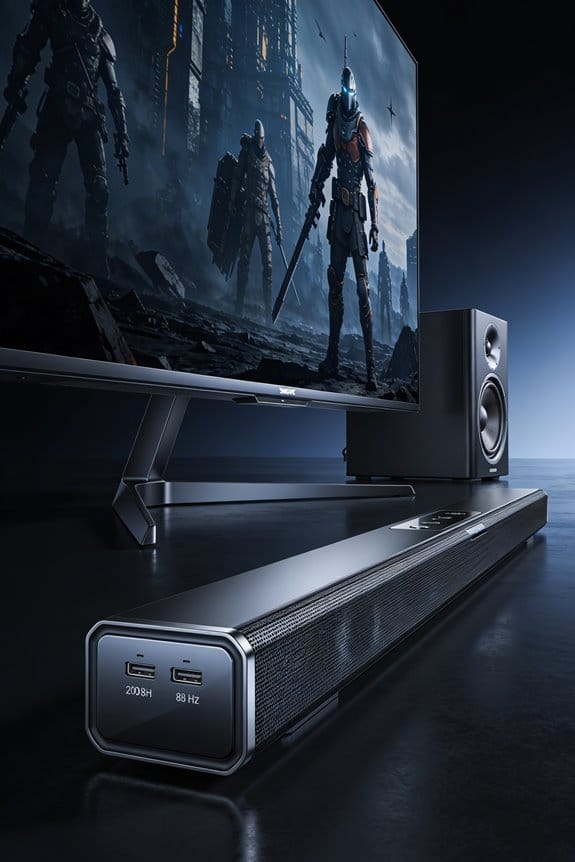
When you’re wandering through ancient ruins or hiking in thick forests while gaming, have you ever noticed how quiet moments can feel eerily empty without the right sound? The frequencies between 20 and 80 Hz are crucial because they create a sensation you can feel in your chest, not just hear. Standard speakers miss this experience; they don’t deliver that gut punch of low-end bass that really brings a scene to life. This kind of bass needs a subwoofer that can vibrate your floor and resonate through your body.
These low-frequency sounds play an important role in setting the atmosphere. Think about things like distant thunder, the sound of a building crumbling, or the tremors that shake the ground below. Without proper bass response, some of these audio elements simply vanish, leaving you with a less engaging experience. Standard speakers just can’t handle the power and size needed for replicating these sounds.
So, what should you do? To fill in those sonic gaps, consider investing in a dedicated subwoofer. This step can elevate your gaming ambiance and make you feel more connected to the game world. The best part is, with a solid audio setup, the entire environment feels far more immersive; it’s as if you’re really part of the action.
Honestly, the right audio equipment can make a huge difference in how you perceive the game’s atmosphere. It’s not just about sound; it’s about feeling present in the game’s world. Recapping, quality low-end bass can transform your RPG experience into something much richer. What sounds have you missed out on in your gaming adventures?
Where to Place Your Subwoofer for Maximum Environmental Impact
Proper subwoofer placement can make or break your audio experience. Have you ever cranked up the volume only to be let down by muddy bass? It’s all about creating that immersive soundscape that pulls you right into the game.
Front Wall Positioning
To get started, try placing your subwoofer along the front wall, ideally about 12 to 18 inches away from the corner. This small adjustment can significantly reduce room mode interference, which can lead to uneven bass throughout your space. When set up right, you’ll find that explosions and environmental sounds become more directional and realistic, especially in open-world RPGs. It’s all about achieving that balance.
Room Acoustics Considerations
Now, here’s the trick: use the “subwoofer crawl” method. Position the subwoofer at your favorite seat, play some bass-heavy music or game sound effects, and then crawl around the perimeter of the room. Stop at spots where the bass sounds even and tight—not boomy or thin. It’s basically like a low-frequency treasure hunt. Mark down any sweet spots you discover; these are where you’ll want to consider placing your sub.
Calibration Requirements
Once you settle on a spot, don’t forget to run your receiver’s room correction software, such as Audyssey or YPAO. This will help fine-tune your subwoofer’s frequency response and make sure it aligns well with your main speakers. Getting this right is key to achieving seamless immersion in your gaming environment.
In short, proper subwoofer placement isn’t just a nice-to-have—it’s essential for a great audio experience. Have you thought about where your subwoofer currently sits?
Tuning Your Sub So It Enhances Surround Speakers, Not Overpowers Them
Finding a good spot for your subwoofer is just the first step. Once you’ve nailed that down, you really want to make sure it enhances your surround speakers rather than drowning them out. Here’s the trick: start by using your receiver’s auto-calibration feature. That little microphone helps measure the balance across all your speakers, so it’s a great way to get moving in the right direction.
So, go into your receiver’s setup menu, head over to “Speaker Configuration,” and let that auto-calibration run while the mic is at your main listening position. After that’s done, you’ll probably want to turn down the subwoofer level by about 2-3 dB. If you’re still feeling like the bass is taking over during your game sessions, this adjustment can make a big difference.
Now, to make sure your tweaks are on point, play some bass-heavy game scenes. Listen closely to explosions and that ambient rumble. You want them to blend seamlessly with the dialogue and other environmental sounds, right? It’s all about adding depth without covering up the important mid-range sounds from your surround speakers.
Honestly, it might take a couple of tries to get everything just right, but when you do, it’ll feel like a whole new experience! So, have you spent time setting up your audio lately? It might be just what you need.
When One Subwoofer Isn’t Enough: Multi-Sub Setups for Large Rooms
Got a big gaming room? You might have noticed that one subwoofer just doesn’t cut it. You’re likely dealing with that frustrating uneven bass response—some areas feel like you’re being blasted while others sound weak and hollow. This is all about how low-frequency sound waves interact with your room’s dimensions, causing peaks and voids throughout the space.
To tackle this issue, think about adding a second or third subwoofer. Placing them in different spots, like opposite corners or on different walls, can significantly smooth out that bass response. Just to give you an idea, here are some benefits of going multi-sub:
- Eliminates dead spots where you barely hear any bass.
- Reduces the chance of locating the bass to one specific spot.
- Creates a more consistent low-frequency output, no matter where you’re seated.
For rooms that are larger than 400 square feet, using at least two subwoofers in a 7.1 or 15.1.8 configuration can really enhance the balance and immersion of the bass. So, why does this matter? It can make a world of difference in how you experience games or movies.
Truth is, with a little extra effort in setup, you’ll enjoy a much more engaging sound experience. Are you ready to bring that bass to life?
Frequently Asked Questions
Do All Open-World RPGS Include Dedicated Low-Frequency Audio Content?
No, not all open-world RPGs include dedicated audio for low frequencies. However, I’ve found that modern titles increasingly feature robust bass content to enhance your immersive experience, making environmental sounds and combat feel more realistic and engaging.
Can a Subwoofer Improve Competitive Advantage in RPG Combat Scenarios?
Studies show gamers react 15% faster to audio cues with proper bass. I’ve found subwoofer benefits include detecting enemy footsteps and spell effects earlier, enhancing combat immersion and giving you essential split-second advantages in RPG battles.
What Subwoofer Wattage Is Recommended for Medium-Sized Gaming Rooms?
I’d recommend 200-300 watts for medium-sized gaming rooms. This wattage guarantees proper subwoofer compatibility with your setup while generating sufficient sound pressure for immersive bass without overwhelming the space or causing distortion during intense RPG moments.
Are Wireless Subwoofers Suitable for Gaming or Do They Introduce Latency?
I’ll be straight with you like a telegram: modern wireless subwoofers work great for gaming. Today’s technology has virtually eliminated latency issues, and you’ll enjoy excellent audio quality without compromising your immersive experience.
How Does Subwoofer Performance Differ Between Console and PC Gaming Setups?
I’ve found that subwoofer performance remains fundamentally identical between platforms. Both console acoustics and PC frequencies output the same low-end signals to your subwoofer. The difference lies in your audio interface quality, not the gaming platform itself.