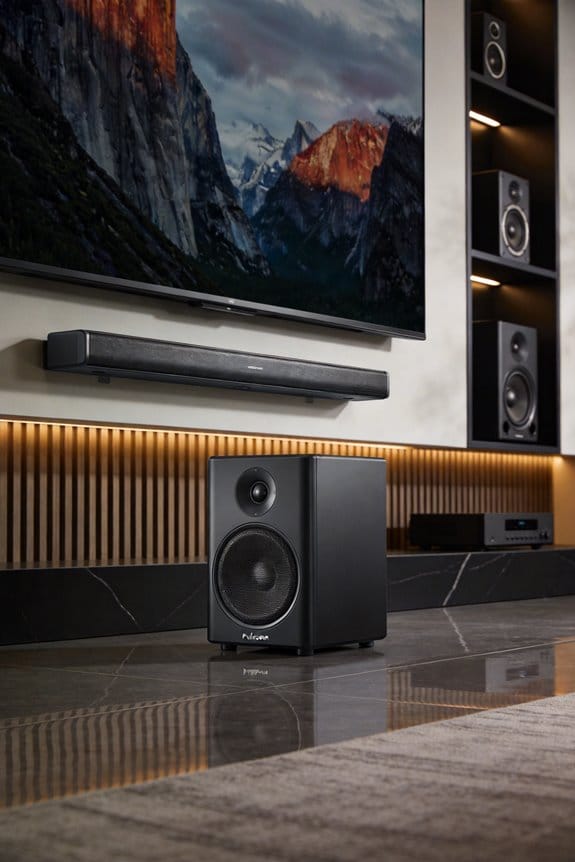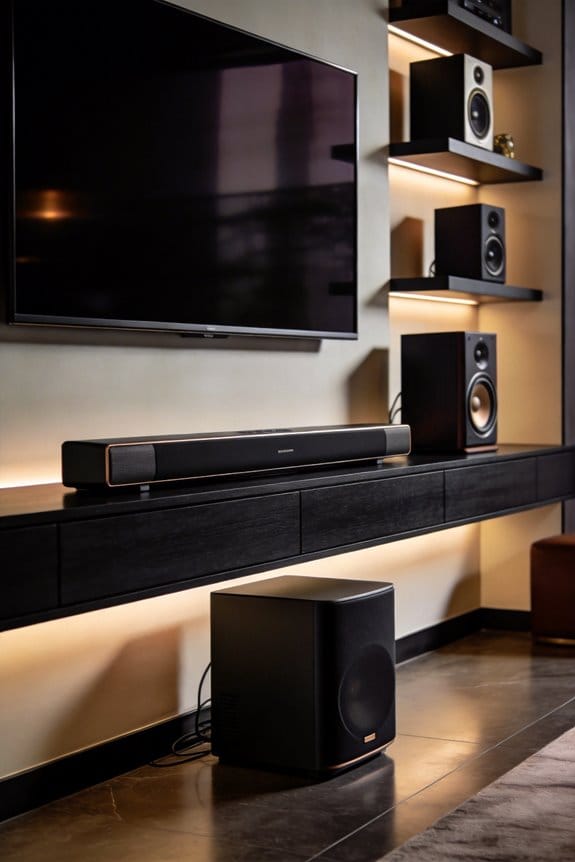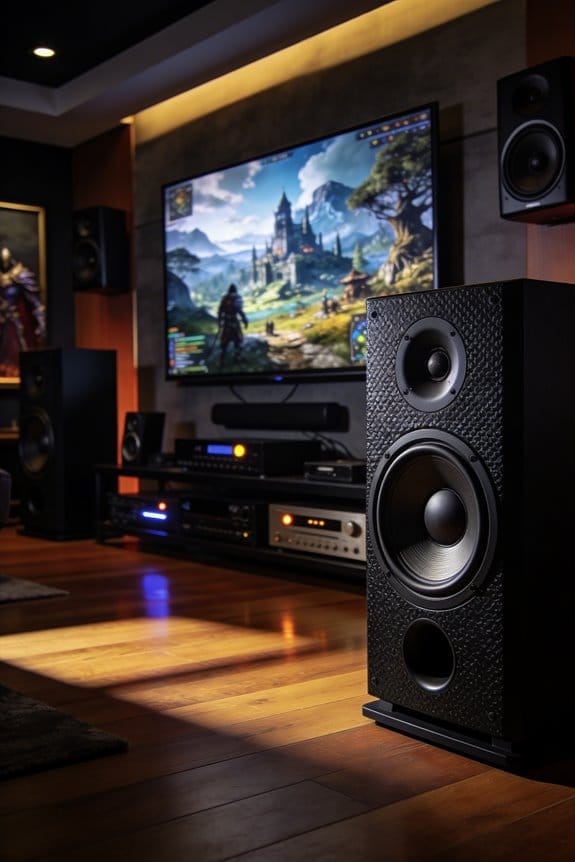


I’ll explain how sub-harmonics in modern movies stress playback hardware through three main mechanisms. First, these frequencies between 40-100 Hz require subwoofers to move considerably more air than standard audio, pushing speakers toward their physical excursion limits and triggering protective limiters. Second, cinema systems need amplifiers exceeding 1000 watts to reproduce these deep frequencies without clipping, especially below 60 Hz where power demands increase dramatically. Third, high-amplitude sub-harmonics generate total harmonic distortion that can damage speaker components if you don’t maintain proper gain staging between your processor and amplification system. Understanding these technical challenges will help you grasp why sound designers must balance cinematic impact with system protection.
Key Takeaways
- Sub-harmonics divide fundamental frequencies, creating deep 40-100 Hz rumbles that require specialized LFE channels and significant amplifier power to reproduce.
- Modern subwoofers risk over-excursion from intense low-frequency motion, necessitating built-in limiters to prevent physical damage during sub-harmonic playback.
- Cinema systems need amplifiers exceeding 1000 watts to adequately power LFE channels handling sub-harmonic content without performance degradation.
- High-amplitude sub-harmonics below 60 Hz push amplifiers toward clipping, requiring careful gain staging and headroom monitoring to maintain quality.
- Total Harmonic Distortion from intense sub-harmonics can damage speakers, requiring technologies like Super-Port and limiting output to 90% capacity.
What Are Sub-Harmonics and Why Do Movies Use Them?

Sub-harmonics might sound like a fancy term, but they really refer to those deep, rumbling frequencies you might not even realize you’re hearing when you watch a movie. When a sound’s fundamental pitch gets divided by whole numbers like 2, 3, or 5, those lower frequencies emerge. Unlike harmonics that layer on top, these sub-harmonics don’t usually happen naturally, which can spark some debate among sound experts.
Have you ever felt the ground shake during a movie explosion or the deep growl of a creature on screen? That’s sub-harmonics at work! When you’re watching films, especially in a theater, those frequencies between 40-100 Hz are blasted through the Low-Frequency Effects (LFE) channel. They bring an intense physical presence to the sound, making everything feel more impactful without overwhelming you with bass.
Take “Mad Max” as an example – sound designers do something really interesting. They route processed audio specifically to subwoofer channels, creating those earth-shattering moments while balancing out the dialogue and main audio channels. The result? You’re pulled into the action with those immersive low-frequency effects that make it all feel real.
Honestly, paying attention to how sound works in films can really change your experience. So, next time you watch your favorite action movie, consider how sub-harmonics are quietly enhancing your viewing pleasure. Got a favorite movie scene where the sound blew you away?
How Sub-Harmonics Differ From Harmonics and Overtones

Have you ever tried to figure out what all these different frequency terms mean? It can get pretty confusing if you’re not deep into sound theory. To help clear things up, let’s break down harmonics and subharmonics.
Harmonics are all about multiplying your base frequency by positive integers. If you’ve got a fundamental pitch at 100 Hz, you’ll find harmonics popping up at 200 Hz, 300 Hz, and 400 Hz. They create those layers of sound that make music rich and full. So, they essentially add to the pitch you’re starting with.
Now, what about subharmonics? These work in the opposite direction. Instead of multiplying, you’re dividing the main frequency by integers. For that same 100 Hz tone, you’d get subharmonics at 50 Hz, 33 Hz, and 25 Hz below the original note. Pretty interesting, right?
Honestly, harmonics just happen naturally when you play acoustic instruments, strum a guitar, or even sing. There’s no need for any fancy gear or tricks; it just works! On the flip side, getting subharmonics to come through can take a bit of extra effort. You might need electronic tools, frequency dividers, or even some special vocal techniques like vocal fry to bring those low notes into play.
So, why should you care about these differences? Understanding them can really enhance your music-making or sound design. The best part is that once you get the hang of it, you’ll start hearing sounds in a whole new way.
The LFE Channel: Where Sub-Harmonics Create Cinematic Power

Have you ever felt your seat vibrate during an action scene in a movie? That’s the magic of the LFE channel at work. This specialized Low Frequency Effects channel handles all those deep sounds below 120 Hz, which is why it’s essential for bringing those heart-pounding moments to life in cinema.
Try this: when you’re setting up your audio, route your subharmonics through aux sends to the LFE channel. Use a high cut filter set at 100 Hz or lower to blend smoothly. Sound designers often focus on the sweet spot between 40-100 Hz. You might find tools like Waves RBass at 40 Hz or LoAir set from 60-76 Hz to be super effective in achieving that punchy feel.
The real trick is keeping your center channel dry while allowing your left and right channels to feed those subharmonics through aux sends. This combo helps you create that immersive, earth-shaking sensation without the issues of boomy bass from the main channels. As a result, your sound stays tight and powerful.
So, why does this matter? Because it can make all the difference when you’re trying to pull the audience into the story. Honestly, getting the LFE channel dialed in can turn an average film experience into something memorable. When you focus on those low frequencies, you give the audience more than just sound—you offer them an experience.
Creating Sub-Harmonics in Post With Waves RBASS and Aux Sends
Imagine you’re working on a track and it’s missing that heart-thumping low end that makes blockbuster films so impactful. How do you get that? Start by creating an aux send from your dialogue or effects track and routing it straight to your LFE channel. Insert Waves RBass on this aux track, and aim for frequencies around 40 Hz. This will generate those sub-harmonics you’re looking for and give your mix some genuine low-end weight. To keep things nice and neat, apply a high-cut filter at around 100 Hz or lower. This will help isolate those deep frequencies from your main channels.
You might want to think about adding a compressor too, like an 1176-style or Softube Summit Audio TLA. This can introduce some harmonic distortion, which can really thicken up that subharmonic content. Here’s the trick: bus your track using Waves LoAir, setting it between 60-76 Hz. Follow that with some compression for a controlled punch. This technique is great for keeping your center channel clean while delivering those powerful subharmonics through the left and right channels.
So, why does this matter? Well, building that low-end depth can take your mix from sounding flat to full of life. Truth is, with a few tweaks in your DAW, you can create impactful soundscapes that resonate.
Why Sub-Harmonics Below 100 Hz Stress Cinema Speakers
Have you ever cranked up that movie on your home theater and felt the bass like a punch to the gut, only to be met with distortion or worse—damaged speakers? That’s because frequencies below 100 Hz can really test your cinema speakers.
When low-end signals kick in, they demand a lot from your equipment. You see, routing those subharmonics to the LFE channel means your subwoofers have to handle frequencies between 40-100 Hz at high volumes. This pushes the speaker cone to its maximum limits. The woofers need to move both forward and backward much further than they’re used to, displacing a substantial amount of air for those deep notes.
So, what’s the catch? This extra travel can sometimes go beyond what the speaker can handle mechanically. When you keep cranking the volume on sustained low-end content, it’s not just the sound quality that suffers—you’re generating heat in the voice coils, putting stress on the amplifier, and risking damage to your speakers. Think about it: it’s a bit like record players. Push them too hard, and you’ll end up with distortion and potentially a blown speaker.
Here’s the trick: if you’re serious about your home theater experience, consider checking the specs of your cinema speakers and match them to the type of content you’re playing. You don’t want to compromise on sound quality just because you love those booming soundtracks. Sustain the excitement without pushing your gear past its limits.
How Subwoofers Handle 40-100 Hz Sub-Harmonic Frequencies
You’ve probably noticed that those low frequencies between 40-100 Hz can really put a strain on your speakers. But what’s really happening inside your subwoofer when it processes these signals? Let’s break it down.
Cone Excursion Mechanics
When those sub-harmonics hit your subwoofer, the cone has to work harder and move further than it does for standard bass frequencies. For instance, a 40 Hz signal really pushes the cone to its mechanical limits. This increased motion can lead to damage if you’re not careful. Modern subwoofers come with limiters to prevent this kind of over-excursion, but it’s still something to keep in mind.
Amplifier Power Requirements
To handle these low frequencies accurately, your amplifier needs to pack a serious punch. Most cinema systems require amplifiers with at least 1000 watts for the Low-Frequency Effects (LFE) channels. It’s worth checking your frequency response curve, too—this will show you where your subwoofer performs best. Just remember that roll-off often happens below the range that the manufacturer claims.
Protection Systems
You might be curious about what protects your subwoofer during all those low-frequency party sessions. Features like Super-Port technology help dampen Total Harmonic Distortion, and they also safeguard your drivers from overheating during those long playbacks of sub-harmonic tunes.
Amplifier Power and Distortion Risks From High-Amplitude Sub-Harmonics
High-amplitude sub-harmonics can push your amplifier into clipping territory faster than you’d expect. Have you ever noticed how certain explosions or rumbles in film soundtracks really demand a lot of power? When those low frequencies drop below 60 Hz, it’s like a test for your amplifier’s capabilities.
If your amplifier can’t handle the power it needs, you’ll start hearing a gritty, unpleasant sound instead of the clean effects you’re looking for. That’s known as sub harmonic distortion, and it can ruin the experience. To check if your system is up to the task, keep an eye on the amplifier headroom while playing content with heavy low-frequency effects (LFE) channel activity.
Here are some tips for protecting your gear:
- Watch your amplifier’s clipping indicators during those loud scenes.
- Make sure you’ve got proper gain staging set up between your processor and amp.
- Double-check that your amplifier has enough power reserves for those fleeting transient peaks.
Also, if you’re into modern subwoofers, consider ones with Super-Port technology. They can help reduce Total Harmonic Distortion, even when the action gets intense.
Protecting Playback Systems With Super-Port and THD Management
When sub-harmonics push your playback system to its limits, Total Harmonic Distortion (THD) can quickly turn into a real headache. If you care about audio quality and want to protect your gear, understanding THD is essential.
Understanding THD Management
Keeping an eye on distortion levels is crucial, especially when you’re jamming out to those low frequencies around 40-100 Hz. Why? Because excessive THD can damage your speaker components and muddy your sound. That’s where Super Port technology comes in handy. It minimizes harmonic distortion, so your subwoofer stays protected from over-excursion, especially during those loud, bass-heavy moments.
Implementation Steps
To get the best performance from your audio setup, consider these tips:
- Set your subwoofer crossover at 80 Hz. This helps manage THD effectively.
- Keep an eye on your amplifier output. Try not to let it clip above 90% capacity to prevent distortion.
- Look for speakers with built-in port designs; they can really help reduce air turbulence.
The best part? Super Port technology helps keep your bass tight and distortion-free, so you can enjoy those deep, cinematic sub-harmonics safely at high volumes without worrying about your equipment wearing out.
In short, keeping THD in check protects your system and enhances your listening experience. Have you tried any of these tips, or do you have your own go-to strategies?
Sub-Harmonic Voice Design in Mad Max and Modern Action Films
Have you ever watched a movie and felt that deep rumble in your chest when a character speaks? That’s often thanks to sub-harmonic voice processing, a trick that really took off with *Mad Max: Fury Road* in 2015. If you want to create those larger-than-life voices yourself, here are some tips to get you started.
First off, get your character’s voice running through a tool like Waves LoAir. Set the frequency between 60-76 Hz to achieve that powerful tone. Then, you can layer in a compressor such as the Softube Summit Audio TLA. This combination will help thicken the sound and create that gritty distortion we often hear in fierce villains or epic creatures.
Here’s the trick: after you’ve got that rough texture, use Renaissance EQ with a low-end bump at around 40 Hz. This helps send those subharmonics to the LFE channel, keeping the center channel clear and focused. The best part is, you can apply this method to all kinds of characters—think monstrous creatures or supernatural beings in action flicks. It really packs a punch in terms of presence without making the sound too muddy.
So, why does this matter? In modern action films, this kind of sound design makes a huge difference in how characters are perceived. You want that earth-shaking presence that makes your audience sit up and take notice.
Frequently Asked Questions
Can Home Theater Systems Reproduce Sub-Harmonics Like Professional Cinema Speakers?
Like a canyon echo fading, I’ve found home theater systems struggle with sub-harmonic fidelity compared to cinema speakers. Your speaker compatibility and audio calibration determine whether those 40 Hz rumbles shake walls or just rattle cheaply.
Do Streaming Services Compress Sub-Harmonic Content Compared to Theatrical Releases?
Yes, I’ve found that streaming compression greatly reduces sub-harmonic content below 40 Hz to save bandwidth. Theatrical releases maintain full audio fidelity in the LFE channel, while streaming services often apply heavy low-frequency filtering that diminishes those powerful rumbles.
Which Movie Genres Rely Most Heavily on Sub-Harmonic Sound Design?
I’ve found that sci-fi films, horror movies, and action thrillers rely most heavily on sub-harmonic sound design for explosions, creature voices, and rumbling tension. Surprisingly, animated features increasingly use them too for impactful scenes.
Are There Hearing Safety Concerns From Prolonged Sub-Harmonic Exposure in Theaters?
Yes, I’d recommend hearing protection during prolonged sub-harmonic exposure in theaters. While cinemas manage levels for audience comfort, extended sessions with intense low-frequency effects above 85 dB can cause fatigue and potential hearing damage over time.
How Do Sound Mixers Test Sub-Harmonics Without Damaging Studio Equipment?
Like a careful pilot testing altitude limits, I’ll use gradual gain staging during sub harmonic testing, monitoring speaker excursion closely. Mixer techniques include starting at -20dB, applying high-pass filters, and using reference monitors before pushing your LFE channel harder.