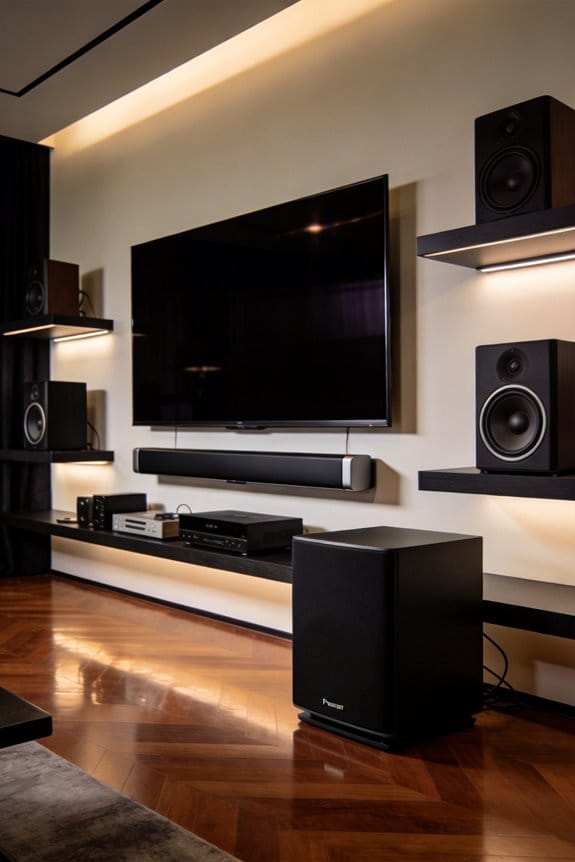

Boomy bass occurs when sound waves between 100-150Hz create standing waves in your room, producing a muddy, lingering low-end that buries clarity in kick drums and bass guitars. I’ll show you that wavelengths of 7-11 feet match typical room dimensions, causing reflections to reinforce rather than cancel each other. You can tame boominess through strategic subwoofer placement using the crawl method, setting crossovers between 80-100Hz, applying high-pass filters at 30-60Hz with 6dB slopes, and positioning dual subwoofers asymmetrically. The sections below explain each technique in detail.
Key Takeaways
- Boomy bass occurs when 100-150Hz frequencies create standing waves due to room dimensions matching wavelengths of 7-11 feet.
- Parallel walls trap bass frequencies, causing phase reinforcement instead of cancellation, resulting in muddy, undefined low-end sound.
- Budget subwoofer construction with thin materials and poor bracing generates artificial resonance that amplifies boominess at lower frequencies.
- Parametric EQ cuts of 3-6dB at problematic frequencies and proper crossover settings between 80-100Hz reduce boom effectively.
- Adding a second subwoofer in opposing positions smooths bass response by creating overlapping wave patterns that minimize room resonances.
What Boomy Bass Sounds Like and How to Recognize It
Have you ever cranked up the bass during a jam session only to find that everything sounds like a blurry mess? That’s boomy bass for you. It creates this overwhelming cloud of sound that just seems to thump away with no real detail, smothering the mids in your music or your room. If you notice bass notes blending into each other without a clear pitch or tone, you’re dealing with boomy bass. It usually hangs around that 100-150Hz range, giving off a long “boooooom” sound that lingers way too long and masks what makes bass instruments stand out.
Here’s how you can pinpoint boomy bass when you hear it:
- Bass guitar notes just come out muddy, losing their distinct melodic qualities.
- Kick drums sound overly rumbling, lacking that punchy clarity you crave.
- Vocals and other midrange instruments get buried under low-frequency noise.
- You might hear the sound starting to lose definition, with notes overlapping and sustaining in a way that feels unnatural.
- If you notice your room vibrating or rattling, that’s a red flag for excessive resonance.
- Moving around your listening space could change the bass level dramatically—definitely not ideal.
So, why does this matter? If you love music, it’s essential to have that clear, punchy bass line that supports everything rather than muddles it. Paying attention to these signs can really help you clean up your sound, whether you’re mixing tracks or just enjoying some tunes at home. Make sure to check for these issues and trust your ears—having a well-defined bass is key to a great listening experience!
Why Bass Gets Boomy at 100-150Hz Instead of Lower Frequencies

Have you ever noticed how your bass sounds thick and cloudy instead of really deep? It’s frustrating when you expect a powerful sound and end up with a boomy mess. Let’s dive into why that happens.
The boominess around 100-150Hz is an issue that many of us face, especially in typical rooms. This frequency range often aligns with the dimensions of our spaces, creating wavelengths between 7 and 11 feet. You guessed it—those dimensions can cause standing waves and resonate too much. On the flip side, lower frequencies below 80Hz can actually pass through walls more easily. They tend to spread out and don’t bounce back as much, keeping reflections to a minimum.
Here’s the deal: phase cancellation, which is crucial for balancing sound, doesn’t always work correctly at these mid-range bass frequencies. Your room’s walls bounce sound waves back at different times, causing them to reinforce each other instead of canceling out. When multiple instruments play in that same 100-150Hz area, they pile up energy. This results in a sound that’s overwhelming and tough for your room to handle.
So, what can you do about it? Here are a few ideas to help clear up that muddy bass:
- Rearrange Your Space: Try moving your speakers or furniture around to see if it helps get rid of some of that messy boom.
- Add Absorption: Use rugs, curtains, or acoustic panels to soak up unwanted reflections.
- Tune Your Setup: Sometimes, a little EQ adjustment can make a big difference. Reduce the gain in those booming frequencies.
Honestly, it’s all about understanding how sound interacts with your environment. With a bit of tweaking, you can transform that cluttered sound into something much clearer and enjoyable. Got any tips or tricks that have worked for you?
How Room Acoustics Turn Clean Bass Into Boomy Mud

When you’re jamming out to bass in an open field, the sound is crisp and defined. But crank up the same bass in your living room, and suddenly it feels like you’re in a different world—one filled with messy, muddled low-end frequencies. So, what’s the deal with all that boomy mud?
Room Reflections Create Phase Problems****
Think about it: bass waves bounce off the walls, floors, and ceilings, arriving at your ears at different times. This mess of room reflections mixes with the direct sound from your speakers, leading to a chaotic battle of frequencies. Some frequencies get amplified (hello, boosted bass!) while others get canceled out completely, leaving you wondering why that bass line sounds off.
Standing Waves Concentrate Energy
Now, if you’ve got parallel walls in a rectangular room, you’re in for a wild ride. Those walls basically trap certain bass frequencies between 80-200Hz, creating standing waves that just pile up energy. Depending on where you’re sitting, you could be feeling an overwhelming bass boom or hearing hardly any at all. Ever notice how just moving three feet can completely change how you perceive the low-end? That’s all about the room’s acoustics.
Why Cheap Subwoofers and Poor Cabinet Design Make Boominess Worse
Ever notice how some subwoofers just sound more boomy than others? It might not just be your room—your subwoofer could be the culprit.
Budget options often skimp on materials, using thin materials that flex and wobble during playback. This creates unwanted resonance instead of delivering that clean bass you want. When the cabinet isn’t sturdy enough, it vibrates at certain frequencies—usually around 40-70Hz—adding that annoying artificial boom to your sound. If you’ve ever placed your hand on the cabinet during a loud passage and felt it shaking, you know exactly what I mean.
Manufacturers often cut corners to save costs. They skip out on internal bracing, use particleboard instead of sturdier MDF, and design ports that are just too small. This leads to air noise every time multiple woofers are pushing out sound. On the other hand, better-quality subwoofers are tuned to resonate below 30Hz and rely on solid amplification. This keeps the sound tight and gives you that controlled output where you really listen.
So, what can you do? If you’re looking to upgrade, consider investing in a heavier, well-built subwoofer with proper bracing and larger ports. You’ll notice the difference when you crank up the volume and the only thing you hear is clean bass rather than rattling vibrations.
To wrap it up, cheap subwoofers and poor cabinet designs can worsen the boominess of your sound. Have you ever experienced a subwoofer that just didn’t cut it?
Where to Place Your Subwoofer to Reduce Boomy Bass
Have you ever noticed your bass sounds a bit off? You’re not alone. Bass waves move in ways that are different from higher frequencies, and where you place your subwoofer can make a big difference in how that sound bounces around your space.
Now, sticking your subwoofer in a corner can boost the bass thanks to boundary reinforcement, but it can also lead to some serious boominess. That’s no fun, right? A great way to tackle this is through the subwoofer crawl method. Start by moving your subwoofer to your listening position, crank up some bass-heavy tracks, and then crawl along the room’s edges. Listen closely as you go; you’re hunting for spots where the bass feels tight and even. Mark down those spots because those might just be perfect for your subwoofer.
It’s also a good idea to avoid putting it in a spot that’s too equal distance from two opposing walls. This can create standing waves, which are not what you want. Honestly, if you’ve got the space, using two subwoofers in different positions can smooth out the bass for multiple listening spots, helping to cut down on that pesky boominess.
How to Use EQ to Cut Boomy Frequencies at 100-150Hz
Are you struggling with a bassline that just feels too muddy? If you notice your mix getting swallowed up by excess boominess, those pesky frequencies between 100-150Hz are likely what’s causing the issue. A parametric EQ can step in here to help you clean things up pretty quickly.
So, how do you tackle it? Start by adding a parametric EQ to your bass-heavy tracks. You’ll want to boost a narrow band by around 6-9dB and then sweep through that 100-150Hz range. This process is all about finding the trouble spots—the frequencies that make your mix sound cloudy and give off that “boooooom” vibe. Once you find the most offensive frequency causing the muddiness, decrease its level by 3-6dB. A medium Q setting of 2.0-4.0 works best since it targets the resonance without stripping away too much of that essential bass body.
When you’re done with the individual tracks, take an extra moment to revisit your master channel. Make subtle adjustments to ensure overall clarity and definition across the board.
Honestly, pinpointing those boomy frequencies can transform your mix from muddy to crisp. So next time you’re mixing, don’t forget to give those low frequencies some TLC! What techniques do you find most effective for cleaning up your bass?
The Right Crossover Frequency to Eliminate Boomy Bass
Crossover frequency settings can make or break your bass experience. If you set the wrong crossover point, you might find your subwoofer and main speakers overlapping in that troublesome 100-150Hz zone, leading to boominess that no one wants. So, try adjusting your crossover between 80-100Hz for most home theater systems. This way, the subwoofer can really focus on delivering those deep bass notes without muddying up the sound.
Don’t forget to check both crossover types on your receiver. You’ll want to look for the LPF (low-pass filter) for your subwoofer and the HPF (high-pass filter) for your main speakers. Matching these settings is crucial for making sure the audio flows smoothly between your components.
Do you ever wonder if your setup is really producing the best sound? You can verify everything’s working as it should by playing some test tones and measuring the frequency response with your receiver’s calibration microphone. If your bass still sounds boomy, try lowering the crossover down to 60Hz. On the other hand, if you’ve got small satellite speakers that struggle with low frequencies, bump it up to 120Hz to give them a fighting chance.
In the end, finding that sweet spot for your crossover frequency can make a significant difference. Consider giving these adjustments a shot and see how your sound improves. What’s the most satisfying bass experience you’ve had?
Volume and DSP Settings That Stop Bass From Sounding Boomy
When it comes to dealing with boomy bass, many folks overlook the volume level of their subwoofer and the DSP settings on their receiver. Trust me, these factors are more important than you might think.
Subwoofer Calibration Steps
Start by setting your subwoofer trim level to about 0dB in your receiver’s menu. If you find numbers like -10dB or -12dB, that’s a sign your subwoofer might not be positioned properly. To get a feel for things, run some listening tests with different source material. This helps you confirm that your bass response is consistent across all kinds of content.
DSP Mode Adjustments
Also, it’s a good idea to turn off any DSP modes that boost bass frequencies. Look out for settings labeled “enhanced bass,” “dynamic EQ,” or “loudness compensation.” These can artificially pump up the low frequencies, leading to that unwanted booming sound.
Volume Adjustments
If your bass sounds boomy at higher volume levels, consider lowering the overall system volume. This usually means the subwoofer is hitting a point of distortion before your main speakers do.
Truth is, tuning your subwoofer and adjusting those DSP settings can make all the difference in your listening experience. Have you noticed an improvement after these tweaks? Give it a try and see how it works for you!
Why High-Pass Filters Remove Boominess Without Killing Impact
Do you find that your bass sounds a bit too muddy or boomy in your mix? It can be frustrating when you just want punch without the clutter. The good news is, a high-pass filter can help with that. It might seem like a weird solution at first, but it actually keeps the impact of your bass intact while clearing out those unwanted frequencies.
Try setting your filter at a 6dB per octave slope. This way, you’re gently cutting out frequencies below your chosen cutoff point without messing with the phase response of your sound. Once you tackle that annoying 30-60Hz range, which typically causes woofers to overexert and leads to cabinet resonance, you’ll find those essential 80-100Hz frequencies shine through much clearer.
So, why is this important? Impact preservation happens because you’re leaving the attack transients and harmonic content above the 100Hz mark untouched. When you roll off the subsonic frequencies that add rumble without any musical value, you’ll notice a significant difference. Kick drums will sound tighter, and your bass guitar will have more clarity. Honestly, it’s a simple step that allows the essential parts of your mix to stand out.
When a Second Subwoofer Solves Boomy Bass Problems
Have you ever noticed that the bass in your room sounds great in one spot but terrible in another? It’s frustrating when you’ve cleaned up the frequencies with a high-pass filter, yet the uneven bass response remains, and that’s because bass waves react differently with the corners and walls of your room depending on where you sit. This can lead to some areas booming while others seem like there’s barely any sound.
Here’s the trick: adding a second subwoofer can help solve those annoying problems. Try placing your first subwoofer in one corner and the second in the opposite corner or along a different wall. This way, you’re creating multiple bass sources, which work together to fill in the gaps where a single sub might fall short.
Frankly, the overlapping wave patterns from dual subwoofers smooth out the response variations and can really tame those boomy spots that often plague single-sub setups. Once you’ve got both subs in place, make sure to set them to identical volume levels through your receiver’s trim menu. That way, you’ll have balanced output across your listening area.
So, why does this matter? Having better bass coverage can make a huge difference in your overall listening experience, whether you’re watching movies or jamming to your favorite tunes. The best part is that with a little experimentation in placement, you can find what works best for your unique space. Just remember, while two subs can make a significant improvement, sometimes it just takes a bit of trial and error to get everything sounding just right.
Frequently Asked Questions
Can Acoustic Panels or Bass Traps Physically Absorb Boomy Frequencies?
yes, I’ve found that acoustic treatment—especially bass traps—can absorb boomy frequencies. They’ll smooth your frequency response by targeting that problematic 100-150Hz range where boominess typically clouds your bass definition.
Does Speaker Wire Quality or Thickness Affect Bass Boominess?
No, I don’t see wire quality affecting boominess directly. However, incorrect wire gauge for your speaker’s impedance can cause power loss and poor damping factor, potentially reducing the amplifier’s control over woofer movement, which might worsen existing boom.
Will Upgrading My Amplifier Reduce Boomy Bass Distortion?
Think of amplifier power like octane in fuel—it won’t fix boominess unless there’s a speaker match issue. I’d focus on room acoustics, subwoofer placement, and EQ adjustments first, since they’re the real culprits behind boomy bass.
Can Headphones Also Produce Boomy Bass or Only Speakers?
Yes, headphones can definitely produce boomy bass. Poor headphone design with excessive bass response around 100-150Hz creates the same boominess you’d hear from speakers. I’ve found cheaper models often overemphasize this frequency range, clouding overall sound definition.
Does Carpet Versus Hardwood Flooring Change How Boomy Bass Sounds?
Yes, flooring materials drastically affect boomy bass. I’ve found that hardwood reflects more sound waves, intensifying bass buildup and boominess. Carpet absorbs reflections, reducing that effect. You’ll notice tighter, less boomy bass with carpeted floors versus hardwood.