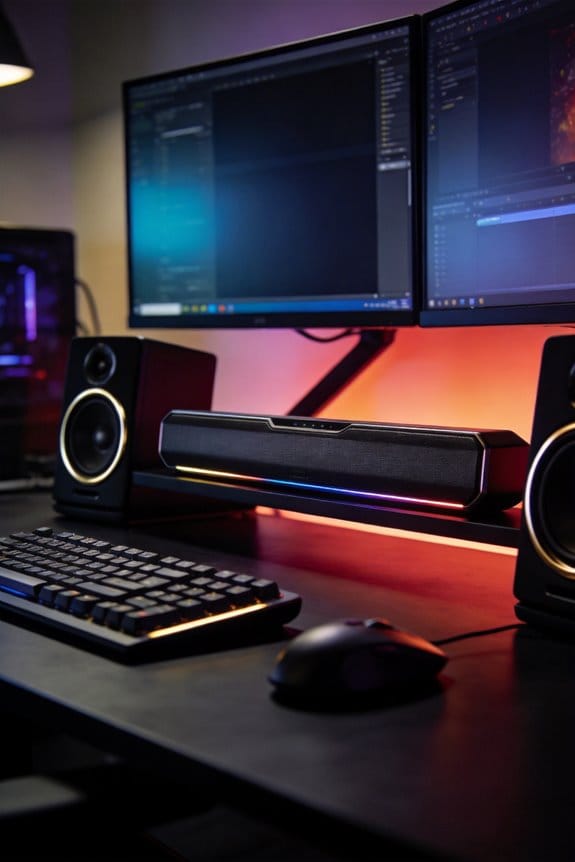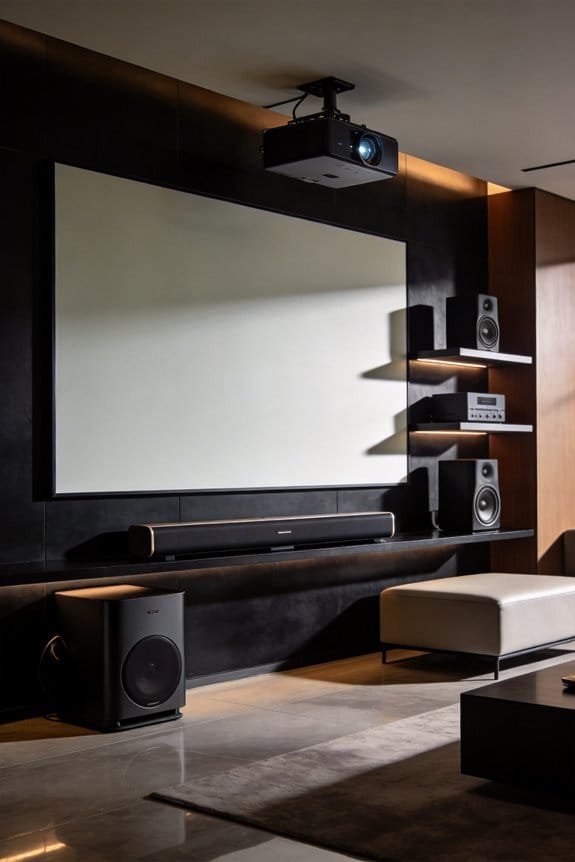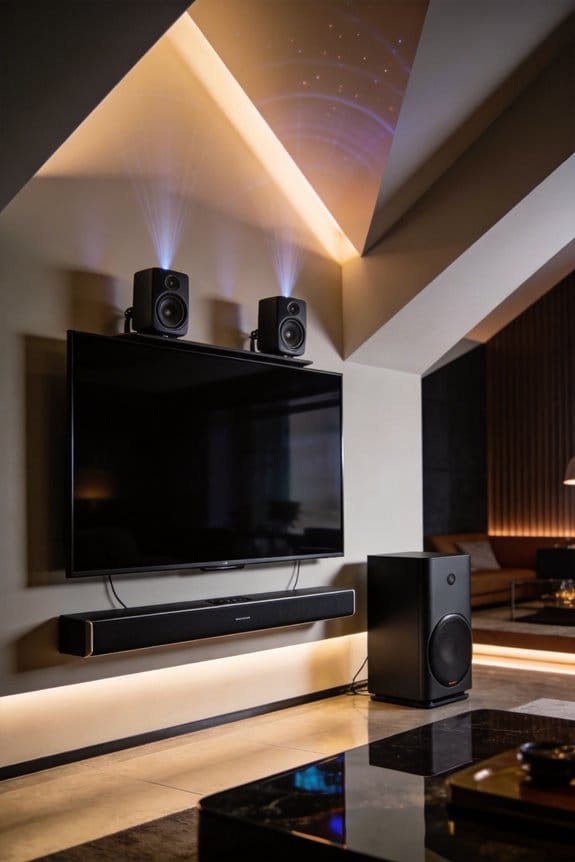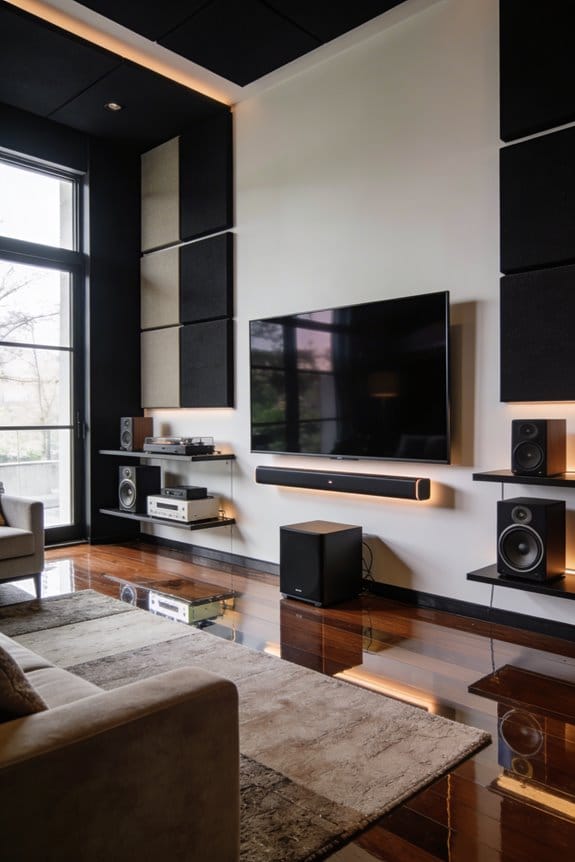
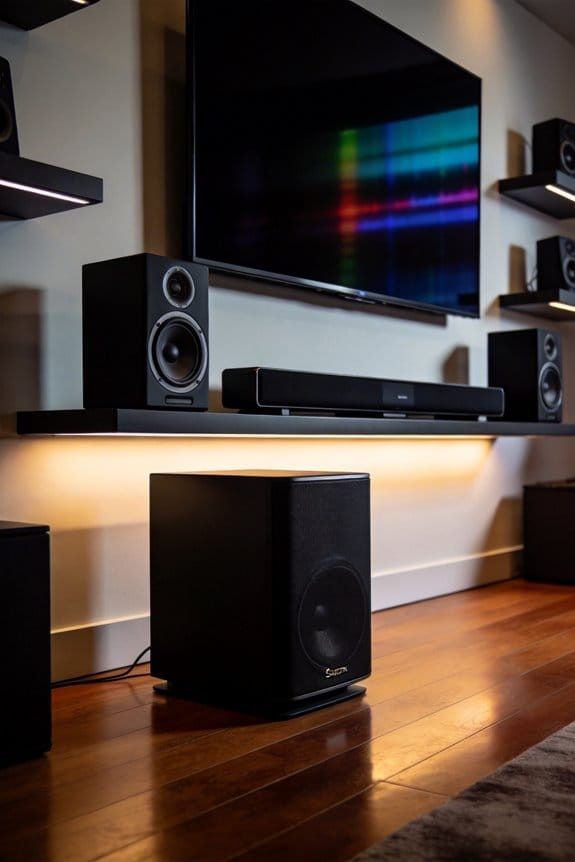

When you listen to speakers in a rectangular room, you’ll hear a frequency response that differs from the speakers’ actual output because sound waves reflect off parallel walls and create standing waves. These reflections amplify certain frequencies while canceling others, particularly affecting bass response below 140 Hz. I recommend measuring your room’s length, width, and height to calculate problematic mode frequencies using the formula with sound speed at 343 m/s. The article below explains positioning strategies, bass trap placement, and ideal room dimension ratios to minimize these acoustic issues.
Key Takeaways
- Room modes create standing waves at specific frequencies determined by room dimensions, causing uneven frequency response with peaks and nulls.
- Axial modes between parallel surfaces dominate low-frequency response, making room dimensions critical for bass reproduction quality.
- Small rooms exhibit wider spacing between modal frequencies, resulting in uneven bass response below the Schroeder frequency around 140 Hz.
- Ideal room ratios (length:width:height) between 1.15-1.45 prevent modal frequency overlap and minimize destructive interference patterns.
- Bass traps in corners and proper speaker placement reduce modal problems by absorbing low frequencies and minimizing boundary reinforcement.
What Are Room Modes and How Do They Affect Your Sound?
Have you ever noticed how the sound in your room can be oddly different depending on where you stand? It’s a real issue, and it all comes down to something called room modes. They’re not just a fancy term—you’ll find they can seriously affect how music or any audio sounds in your space.
There are three main types of modes you should know about:
- Axial Modes: These happen between parallel surfaces, like walls that face each other.
- Tangential Modes: These involve four surfaces, meaning they’re more complex.
- Oblique Modes: These include all six boundaries of your room, which makes them the trickiest.
Room modes are especially pronounced in low frequencies. Why does that matter? Well, low-frequency sound waves have longer wavelengths, which means they tend to bounce around more and fill your space differently compared to higher frequencies. As a result, certain frequencies can feel louder or quieter depending on where you are in the room.
So, how can you improve the sound in your space? Here’s what you can try:
- Begin by assessing your room dimensions.
- Experiment with furniture placement; shifting a chair or a couch can make a difference.
- Consider adding sound-absorbing materials, like rugs or curtains, to help even things out.
The real kicker is that sometimes, just moving a few things around can change how sound waves travel, making your listening experience so much better! Honestly, it’s all about understanding how your room interacts with sound.
Wrapping it up, room modes can significantly influence your audio experience. What changes are you ready to make for a better sound?
How to Calculate Room Mode Frequencies in Your Space?
Are you struggling with uneven bass in your room? Those pesky room modes might be the culprit, and understanding how to calculate their frequencies can really help improve your listening experience.
To get started, you’ll need to measure your room’s length, width, and height in meters. The formula is pretty straightforward: take the speed of sound, which is 343 meters per second, and divide it by twice the dimension you’re measuring. If you’re more comfortable with feet, just divide 1,130 by twice your dimension in feet.
Now here’s the interesting part: your longest room dimension will give you the lowest frequency mode. Run through the calculations for all three dimensions, and don’t forget to also multiply each result by 2, 3, and 4 to identify additional harmonics. This sound frequency analysis will point out those problematic frequencies, pinpointing where standing waves create that frustrating uneven bass response you’ve been experiencing.
So, why does this matter? By understanding these frequencies, you can take steps to mitigate those issues. Honestly, it makes a huge difference in how music and other audio sound in your space.
Wrap it all up by keeping those frequencies in mind as you plan your acoustics solution. What changes could you make to create a more balanced sound environment?
Why Small Rooms Have Worse Room Mode Problems?
Are you struggling with sound quality in your small room? You’re not alone. Small spaces can make for some real challenges when it comes to room acoustics. The issue at hand is that the spacing between room mode frequencies is much wider, which results in noticeable gaps in your frequency response.
In homes, many rooms don’t have enough modes below 250 Hz, where standing waves really start to mess with your sound. To put it simply, the Schroeder frequency—this concept that describes the transition point between different acoustical behaviors—sits around 140 Hz in a typical small room. This means you might end up with uneven bass response throughout a big chunk of what you can actually hear.
Think about it: large spaces, like churches, have their Schroeder frequency sitting around 30 Hz. This gives them a much better distribution of modes. Smaller rooms just don’t have the same luck; they tend to produce fewer low-frequency modes. This leads to problems like clustering, where some bass notes are overemphasized while others vanish completely. Not exactly the listening experience you want, right?
So, what can you do about it?
- Consider room treatment. Adding some acoustic panels can help smooth out those problematic frequencies.
- Experiment with placement. Moving your furniture or audio equipment can make a difference in how sound waves bounce around.
- Use a subwoofer wisely. It might be tempting to crank it up, but balancing it with the rest of your system is key.
The best part is that even small changes can yield better sound. Ultimately, understanding how your space interacts with sound can lead to a more enjoyable listening experience.
Have you ever noticed how your music sounds so much better in a different space? It’s all about the acoustics.
What Room Dimensions Prevent Room Mode Clustering?
Are you struggling with echo-y or uneven sound in your space? Room acoustics can feel overwhelming, but picking the right dimensions can really help prevent those bothersome mode clusters.
Try this: aim for a length-to-width ratio between 1.15 and 1.45. This simple tweak can make a big difference in how resonant frequencies are spread out. The best ratios to shoot for, especially if your room is up to 150 cubic meters, are 1:1.48:2.12, 1:1.4:1.89, and 1:1.2:1.45. It’s also super important to keep your width-to-height ratio above 1.1; this way, you can cut down on sound wave interference.
So, why does this matter? When standing waves pile up at the same frequencies, they can cause nasty peaks and nulls in your room’s sound response. If you’re working on music production or just love critical listening, these dimension ratios will help manage low-frequency resonances in spaces under 300 cubic meters.
Honestly, taking these simple steps can help you create a much more enjoyable listening environment. Remember, good acoustics matter, and they can dramatically improve your audio experience! What’s your next step to make your space sound better?
How to Fix Room Modes With Bass Traps and Positioning?
Room modes can really mess with your sound quality, especially in rectangular spaces. If you’re struggling with these acoustic issues, you’ll want to dive into some bass trap placement and speaker positioning strategies that actually work.
Bass Trap Types
First off, try placing porous absorbers in the corners of your room. This is where those pesky axial modes build up pressure the most. Membrane absorbers can also be a solid choice; they help dissipate those low frequencies below 100 Hz by using panel vibration. If you’ve done some impulse response testing and identified specific problem frequencies, consider adding Helmholtz resonators to the mix.
Positioning Strategies
Here’s the trick: move your speakers at least 3 feet away from the walls. This will help cut down on the boundary reinforcement that can amplify those modes in your sound. Now, for your listening area, aim to sit about 38% of the way into the room from the front wall. Steering clear of the center is key, since that’s usually where the nulls tend to cluster.
Try testing out different spots using pink noise and some measurement software. It might take a bit of trial and error, but you’ll find the locations that give you the smoothest frequency response.
Frequently Asked Questions
What Is the Schroeder Frequency and Why Does It Matter?
The Schroeder frequency marks where room modes shift from sparse to dense spacing. I’ll explain its relevance: below it, individual resonances dominate; above it, they blend smoothly. This frequency’s implications determine which acoustic treatments you’ll need for ideal sound quality.
How Do Tangential and Oblique Modes Differ From Axial Modes?
I’ll explain the key difference: tangential modes bounce between four room surfaces, while oblique modes ricochet across all six boundaries. Both are weaker than axial modes, which reflect between just two parallel walls.
Can Asymmetrical Room Shapes Eliminate Room Mode Problems Entirely?
No, I can’t eliminate room mode problems entirely with asymmetrical design. While asymmetrical room acoustics help distribute modes more evenly across frequencies, they don’t remove resonances—they just make them less predictable and potentially smoother overall.
What Measurement Tools Are Best for Identifying Room Mode Issues?
Ironically, your ears alone won’t reveal what’s sabotaging your sound. I’d recommend using dedicated room measurement software with calibrated microphones for proper mode analysis—tools like REW or FuzzMeasure excel at visualizing problematic frequency response peaks and nulls.
Do Ceiling Treatments Affect Room Modes as Much as Wall Treatments?
Ceiling panels have less acoustic impact on axial room modes than wall treatments because the strongest low-frequency modes occur between parallel walls. However, I’d still recommend ceiling treatment for controlling tangential modes and reflections affecting overall sound quality.