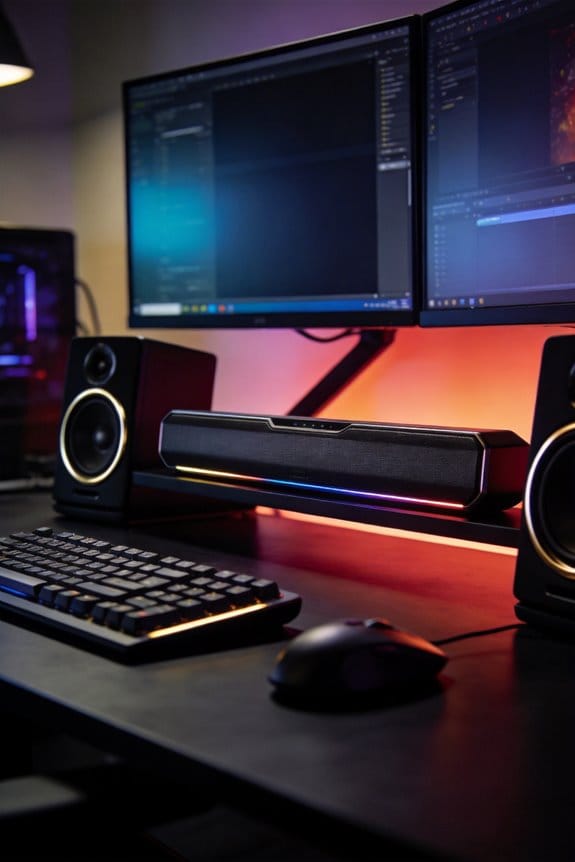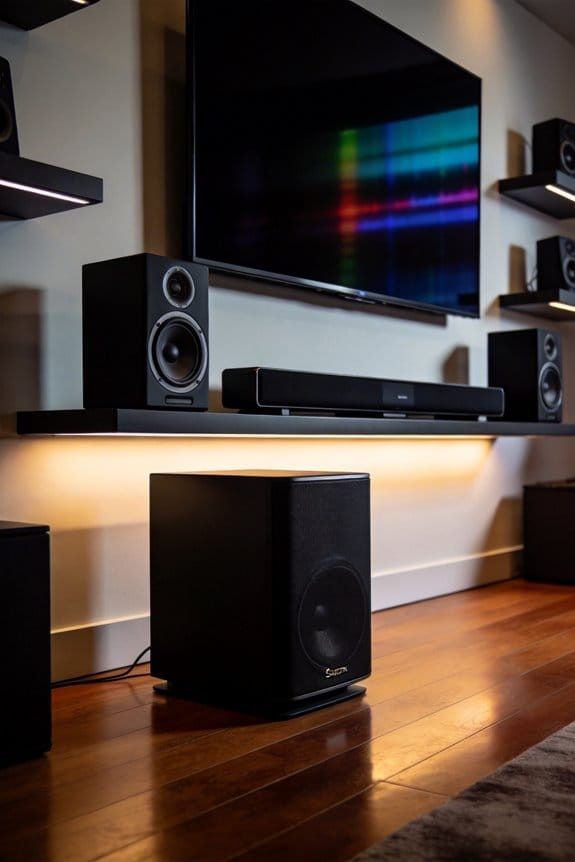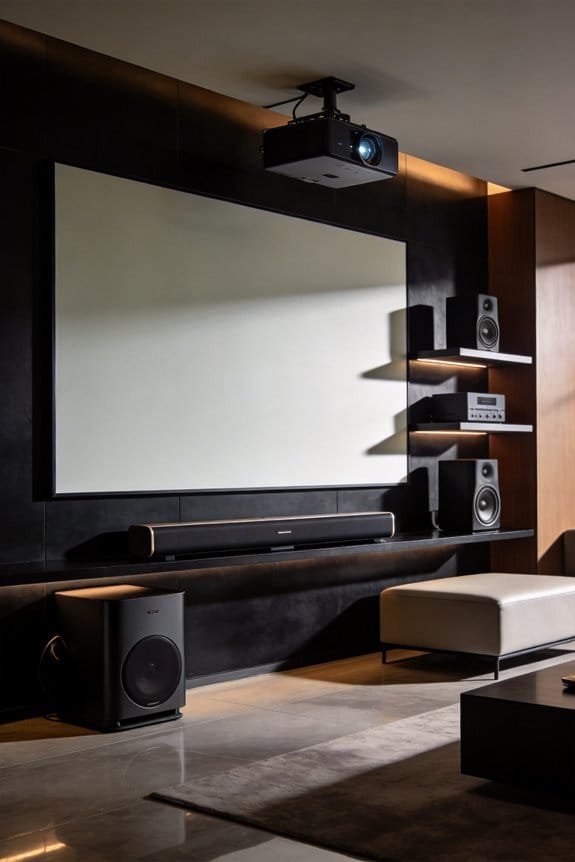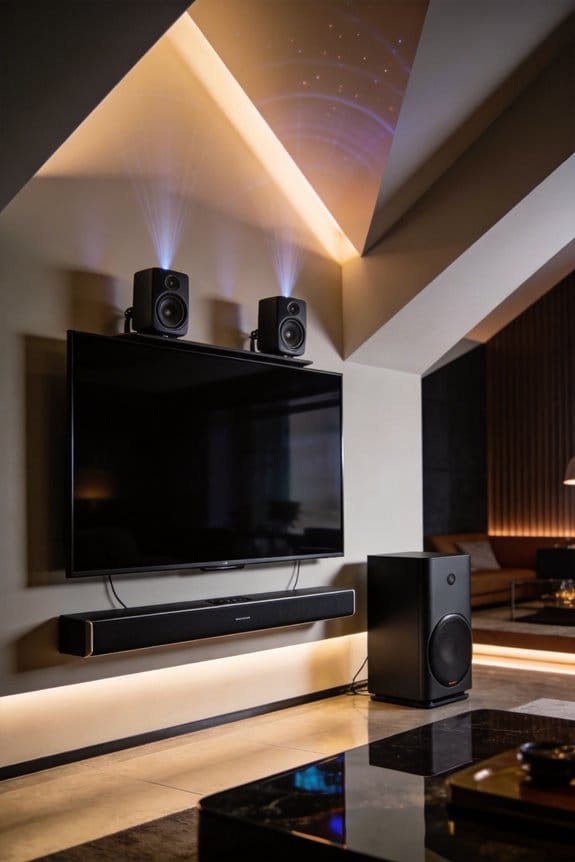
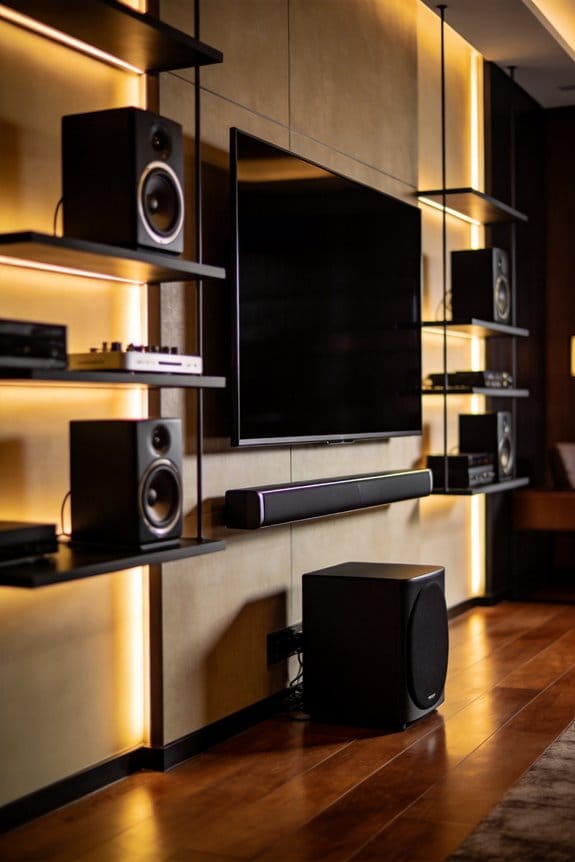

I’ll show you how the rule of thirds optimizes your surround sound setup by dividing your room’s longest wall into three equal sections. Measure the wall length, divide by three to create two division lines, and place your couch at the second line. Position your left and right speakers at the first division, spacing them to form an equilateral triangle with your listening spot. Place surround speakers at 135-150 degree angles from center, mounting them 2-3 feet above ear level. The sections below explain precise measurements and adjustments.
Key Takeaways
- Divide the longest wall into thirds to establish optimal speaker placement zones at one-third and two-thirds positions.
- Position left and right speakers at the first division line, typically 6 feet in an 18-foot room.
- Place the main listening position at the second division line, approximately 12 feet from the front wall.
- Create an equilateral triangle between speakers and listening spot, with equal distances from each point.
- Position surround speakers at 135-150 degree angles, 2-3 feet above ear level from the main seating area.
Calculate the Rule of Thirds Grid for Your Room

Have you ever set up a sound system only to feel like something’s off? Getting that perfect sound takes a bit of planning, starting with how you lay out your room.
First, you’ll want to measure the longest wall, from front to back. Whether you use a tape measure or a laser distance finder, just make sure it’s as accurate as possible. Jot down this measurement in feet and inches—this is your starting point. Now, take that total length and divide it by three to create your Rule of Thirds grid.
Let’s say your room is 18 feet long. Each section will end up being 6 feet. To get your speakers in the right spot, mark your first division line at 6 feet from the front wall; this is where your left and right speakers will go. The second line, at 12 feet from the front wall, will be your main listening position. So, why does this matter? Because this grid not only gives you a framework for your speaker placement but also helps set the stage for an amazing surround sound experience.
Honestly, taking the time to map out your space can make a big difference in how your audio setup performs. It’s not just about tossing speakers wherever; you’re creating a space that works for you.
To sum it up, measure, divide, and mark your grid—it’s that simple. Are you ready to transform your room into a listening oasis?
Position Your Listening Spot at the Second Third Line

Ever wondered why your home theater sound doesn’t quite hit the mark? Getting that perfect audio experience can be tricky, but I’ve got a simple tip for you. Start by positioning your couch as the anchor for your surround sound setup. Aim for that second division line, around 12 feet from the front wall, and you’ll be well on your way to achieving better sound quality.
By placing your main listening spot right on that second third line, you’ll be sitting pretty, equidistant from each speaker in that nice triangular layout. This arrangement helps create a balanced audio landscape and keeps sound well-distributed across all channels. Just think about it: when each speaker has the same distance to your ears, it’s much easier to enjoy clear dialogue and immersive soundscapes.
To get this spot just right, measure from the back wall to your couch. Trust me, it’s worth it. That second third position helps avoid issues like parallel wall reflections and bass problems, which can mess with the overall room response. If you find that the sound isn’t quite right—like if the dialogue sounds muddy or the imaging feels off—try adjusting your seat in 6-inch increments. Move forward or backward until you find that sweet spot where everything just clicks.
Place Front Speakers Using the Equilateral Triangle

So, you’ve finally got your space set up for the ultimate sound experience, but what’s next? It’s all about positioning your front left and right speakers to create that perfect equilateral triangle with your ears as the third point. This setup might sound complicated, but trust me, it’s pretty straightforward.
First things first, measure the distance between your left and right speakers. Whatever that distance is, you’ll want your listening position to be the same from each speaker. For instance, if you’ve got them sitting 10 feet apart, your ears should be at a comfy 10 feet from each speaker too. Using a laser measure or tape measure helps ensure everything matches just right—accuracy is key here!
Here’s the trick: once you’ve got the speakers in place, angle them inwards around 22 to 30 degrees toward your listening spot. This toe-in adjustment isn’t just for looks; it’s vital for getting that crystal-clear sound imaging. Think about it—when everything is positioned correctly, you’re not just listening to music or movies; you’re experiencing them as they were meant to be heard.
So, why does this matter? Because when your speakers are set up properly, they create a balanced stereo soundstage, making sure the audio feels immersive and precise. This isn’t just about better sound quality; it’s about enhancing your whole listening experience.
In short, getting your speakers placed just right is crucial for a dynamic sound experience. Have you tried adjusting your speaker angles recently to see how it changes your listening experience?
Add Your Center Channel to Complete the Front Stage
The center channel speaker is often overlooked, but getting its placement right can make a world of difference when enjoying your favorite movie or show. You’ll want to position it directly above or below your display screen, landing right in the sweet spot between your left and right front speakers. Here’s a simple trick: measure to find the exact midpoint between those speakers, ensuring the center channel sits equally spaced from both sides.
Now, let’s talk about height. Ideally, the tweeter (that’s the small speaker part) should be aligned with your seated ear level. However, if it has to go below the screen, that’s usually fine for most setups. It’s all about keeping that equilibrium! Your seating should form the tip of an equilateral triangle, with the center channel serving as the base alongside the left and right speakers.
So, why does this matter? Proper placement helps ensure that dialogue is crystal clear and the front soundstage feels seamless. If your center channel ends up being quite a bit above or below your ears, angle it toward your main seating area to help direct the sound where it needs to go.
Position Surround Speakers at 135–150 Degree Angles
So, you’ve got your center channel all set up, but what about the surround speakers? That’s where the magic really happens. To create a truly immersive sound experience, you’ll want to position those surround speakers at just the right angles. Aim for a range between 135 and 150 degrees from your center channel, using your main listening spot as your reference. This setup helps avoid that annoying point-source effect right behind your head, ensuring a smooth surround sound experience.
When it comes to placement height, try mounting those surround speakers about 2-3 feet above your seated ear level. This little trick creates a more diffuse sound that really enhances the overall audio environment. You can use a protractor or even a smartphone app to get those angles spot on. Starting with 135 degrees works well for smaller rooms, but if you’ve got the space, feel free to stretch it closer to 150 degrees.
Now, let’s not forget about side surrounds. Positioning them wisely helps with audio panning, letting the sound transition seamlessly from the sides to the back. This small detail can significantly enhance your cinematic or gaming experience.
To wrap it all up, getting the right angles and heights for your surround speakers transforms your setup. So, why not take a little time to fine-tune those speakers? After all, it’s all about creating that immersive sound stage you love. What steps will you take to level up your audio?
Adjust Speaker Placement in 1-Foot Increments for Your Room
Are your speakers sounding off, but you can’t quite figure out why? Fine-tuning speaker placement can make a significant difference in how your audio feels. It’s like cooking; sometimes you need to adjust the ingredients to get everything just right.
Start with the rule of thirds as your guideline. Place your front left and right speakers at the one-third mark of the room’s width. From there, try moving them in 1-foot increments—both forward and backward. It may sound tedious, but small adjustments can reveal the sweet spot for clarity, imaging, and bass response that you didn’t know was missing.
Here’s the trick: as you make these shifts, pause and listen carefully. Jot down the distances—you can use a tape measure to track how far you’ve moved them, noting positions like 66 inches from the front wall or 78 inches. This way, you’ll have a reference for what works best in your specific space.
Of course, this can take some time and patience, but if you’re serious about getting great sound, it’s worth it. So, why does this matter? Because every room has its own quirks, and finding that perfect spot can enhance your overall experience.
In the end, you might find that just a foot one way or the other transforms your setup. Don’t hesitate to experiment! What adjustments have you made that changed how you hear your favorite music or movies?
Frequently Asked Questions
What Is the Optimal Toe-In Angle for Front Speakers?
I’d recommend 22-30 degrees toe-in adjustment for your front speakers—that’s the sweet spot I’ve found works for 80% of setups. Proper angling creates incredible speaker synergy, delivering that precise soundstage you’re after.
How High Should Surround Speakers Be Mounted Above Ear Level?
I’ll mount your surround speakers 2-3 feet above your seated ear level height. This elevation creates an immersive soundfield while preventing point-source localization. Proper mounting techniques at this height guarantee smooth sound panning from sides to rear positions.
Can the Rule of Thirds Work in Non-Rectangular Rooms?
The rule of thirds serves as a starting point, but I’d need to adapt speaker placement strategies for non rectangular layouts. I’ll use trial and error, testing positions in one-foot increments to optimize your room’s unique acoustics.
What Distance Should Side Surrounds Be From the Listening Position?
Side surrounds don’t have a specific surround speaker distance requirement in the rule of thirds. I’d maintain the equidistant arc from your listening position adjustment, matching your front speaker distances while positioning them at 90-110 degrees laterally.
Should I Use Critical Distance Positioning Instead of Rule of Thirds?
I’d start with rule of thirds, then test critical distance placement strategies. Critical distance positions you 1-1.5 feet behind the thirds spot, optimizing direct versus reflected sound balance for your specific room’s acoustic characteristics.