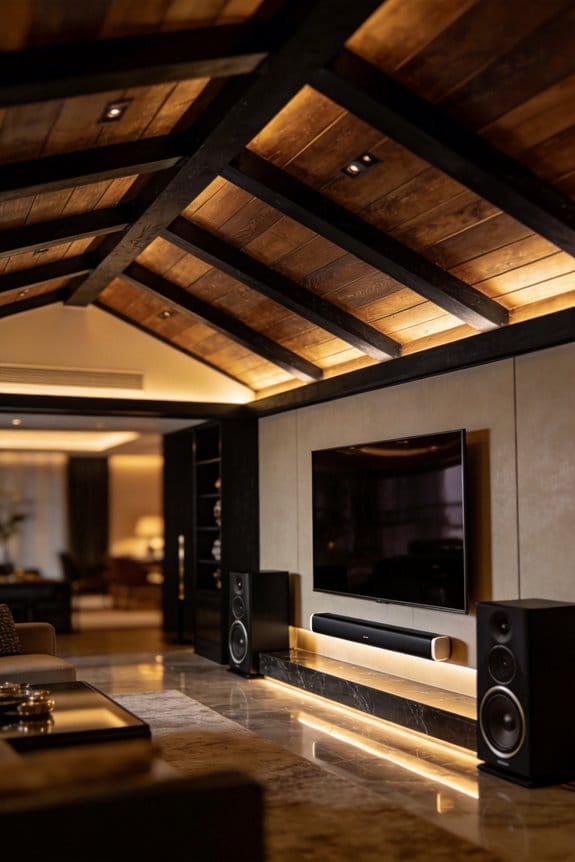

Vaulted ceilings create uneven sound distribution through complex reflections off angled surfaces, amplifying certain frequencies while cancelling others, particularly below 100 Hz where bass dips occur. I’ve found that drop ceilings absorb mid-to-high frequencies excessively, making dialogue unclear and reducing clarity. Both ceiling types require strategic placement of bass traps in corners, foam panels at reflection points, and diffusion treatments on slopes to control these issues. You’ll need Room EQ Wizard software with a calibrated USB microphone to measure frequency response from 20 Hz to 20 kHz, then combine physical treatments with AVR calibration systems like Audyssey for ideal results that I’ll explain further.
Key Takeaways
- Vaulted ceilings create uneven sound distribution, amplify certain frequencies, and produce complex reflections that muddy dialogue and high-frequency clarity.
- Bass frequencies below 100 Hz experience severe dips and peaks due to sloped surfaces creating irregular room modes.
- Drop ceilings can help control reflections but may reduce ceiling height, affecting speaker placement and vertical sound staging.
- Comprehensive acoustic treatment including bass traps, absorption panels, and diffusers is essential for managing vaulted ceiling acoustics.
- Atmos and surround speaker placement requires adjustable brackets and careful measurement to compensate for angled ceiling surfaces.
How Do Vaulted Ceilings Cause Acoustic Problems in Home Theaters?
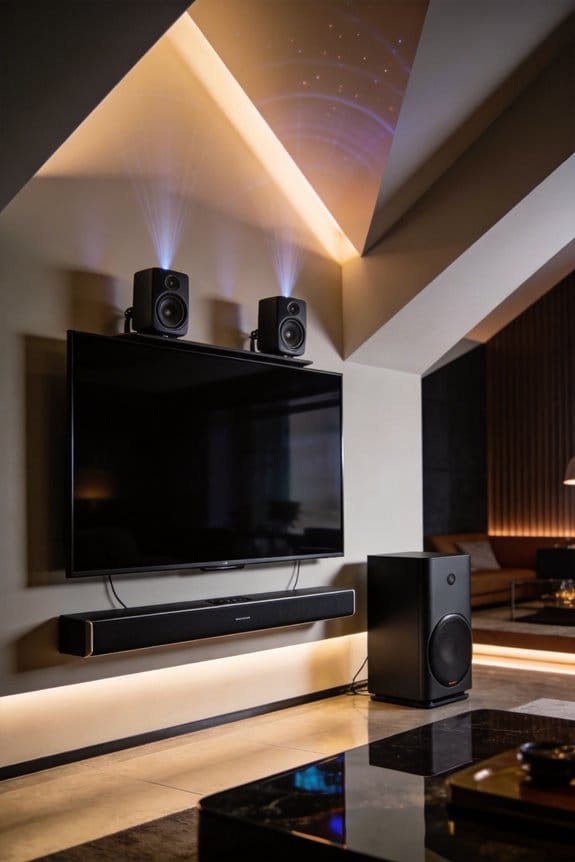
Vaulted ceilings can look gorgeous in a home theater, but they come with some real acoustic headaches. Ever noticed how some spots in the room sound booming while others seem flat? That’s because those sloped surfaces create uneven sound distribution, turning your listening experience into a bit of a guessing game.
Here’s where it gets sticky. The irregular angles amplify some frequencies and completely cancel others out. You might be straining to catch dialogue or the highs in your favorite music because reflections are bouncing off those angled walls, creating a confusing mess of echoes. It’s frustrating, right?
Bass can be particularly tricky in these setups. With varying ceiling heights, you can encounter what are known as “double dips” in sound below 100 Hz, plus 20 dB swings in frequency response. This means that as you move around your seating area, the low-end might hit hard in one spot but be practically inaudible just a few feet away. So, why does this matter? If you care about good sound in your home theater, it definitely should.
Echo reduction isn’t as straightforward either. Those funky angles complicate things and make it tough to predict sound paths. You’ll need way more acoustic treatment than you would in a standard rectangular room to get things sounding right.
To sum it up, vaulted ceilings can really throw a wrench into your home theater experience. If you’re thinking about tackling this challenge, it’s all about being aware of these issues and planning accordingly. What are some sound solutions you’ve considered for your space?
What Acoustic Treatment Types Work Best for Vaulted Ceilings

Ever walked into a room with a vaulted ceiling that just felt off? You’re definitely not alone. When it comes to home theaters, these angled ceilings can really mess with your sound quality. So, how do you tackle those annoying acoustic issues?
First, let’s talk about bass. Most problems in vaulted ceilings stem from low-frequency buildup, especially in the 60-80 Hz range. This is mainly due to weird floor-to-ceiling dimensions. To combat this, consider installing bass traps in the corners of the room. You want them going from the starting point of the vaulted ceiling all the way down to the floor. This setup is crucial for tackling that pesky low-frequency overhang.
Now, for mid-to-high frequencies, foam panels are a solid option. Just remember, if you’re looking at those 2-inch versions, they won’t do much for bass control, so keep that in mind. Sound diffusion panels can also be a lifesaver—these guys are great at scattering reflections off angled surfaces. Where should you put them? Stick them on the angled parts of your ceiling to break up flutter echoes. It’ll really help even out the sound throughout the room.
When it comes to the sidewalls and those upper corners, fabric-wrapped absorbers are worth considering. They tackle a broad range of frequencies, which can dramatically improve your listening experience.
Truth is, with a little planning and the right treatments, you can transform your vaulted ceiling room into an acoustic haven. So, what’s the first thing you’re going to try?
Where to Place Bass Traps and Panels in Angled Rooms

Angled rooms can be tricky when it comes to sound. You might find that your music or recordings don’t quite hit the same way they do in a more traditional space. So, how do you tackle the unique acoustic challenges? It all boils down to where you place your bass traps and panels.
Bass Trap Placement
To really deal with those bass issues, think about installing bass traps where your vaulted ceiling meets each wall. You’ll want to extend them from floor to ceiling. Instead of sticking them flush against the slope, aim for that start point of the angled ceiling. Most response problems happen in the 60-80 Hz range, and it’s usually due to floor-to-ceiling dimensions.
Panel Positioning
Now, let’s talk about acoustic panels. The trick is to mount 4-inch panels on your ceiling at the first reflection points. These are the spots where sound bounces toward where you sit. Make sure you focus on the areas directly above your seating and right between your speakers. You’ll often measure from your highest peak, usually around 13 feet, down to 8-foot sidewalls for the best coverage.
Does this really make a difference? Absolutely! These small changes can have a big impact on your sound quality. Just remember, sound travels in ways we can’t always see, so paying attention to where you place your traps and panels is key. Trust me, it’s worth the effort to get it right!
How to Measure and Fix Frequency Response in Vaulted Spaces
Once you’ve set up your bass traps and panels, you might be wondering if they’re actually doing their job. To find out for sure, measuring your room’s frequency response is key. I suggest trying out Room EQ Wizard software along with a calibrated USB microphone like the UMIK-1. Just place the mic at your main listening spot and run a sweep from 20 Hz to 20 kHz. This will help you spot any remaining peaks, nulls, and those annoying 60-80 Hz dips.
After running that sweep, you’ll see some graphs that show the amplitude changes across the frequency spectrum. These visuals will clue you in on where you still need more treatment. So, what’s next? Once you’ve done your physical setups, run the response calibration with your AVR’s built-in systems like Audyssey or Dirac Live. It’s a solid two-step process—start with physical absorption, then tackle digital correction for the best results, especially in those tricky vaulted spaces.
Honestly, taking the time to measure can make all the difference. It’s not just about slapping on treatments; it’s about ensuring they actually work together. Have you ever considered how crucial this step is for achieving that perfect sound? Don’t skip it; you’ll thank yourself later. Remember, your listening space deserves the right attention!
Setting Up Atmos and Surround Speakers on Angled Ceilings
How do you mount Atmos speakers when your ceiling slopes at those tricky angles? It can be a real challenge, but I’ve got some straightforward tips to help you out. Start by measuring the peak height—this is usually around 13 feet—and then find spots on the slope that drop down to about 8 to 9 feet for practical speaker placement.
Try using adjustable ceiling brackets that can handle 25 to 30-degree angles. These allow you to tilt the drivers toward your listening position, which is key for good sound. For proper Atmos setup, you’ll want to position your speakers at the reflection points from your main sitting area. Maintaining symmetry is important, so be sure to place them at equal distances from the sidewalls, even if your ceiling height varies by 3 to 5 feet across the room.
Here’s the trick: make sure to secure the mounts into the ceiling joists with some sturdy 3-inch lag bolts. It’s a small step that really pays off in the long run. And don’t forget—angle those drivers about 15 degrees downward to account for that vaulted ceiling. So, why is this crucial? Proper angling helps ensure that sound gets delivered right where you need it for an immersive experience.
To wrap it up, figuring out how to mount your Atmos speakers in an angled ceiling isn’t as daunting as it seems. Just take your time, follow these steps, and you’ll be enjoying that amazing sound in no time! What’s the most challenging part of setting up your theater for you?
Frequently Asked Questions
Can Drop Ceilings Improve Home Theater Acoustics Better Than Vaulted Ceilings?
Yes, I believe drop ceilings offer superior acoustics for your home theater. Drop ceiling advantages include standardized acoustic panel integration and predictable sound behavior, while vaulted ceiling limitations create frequency response issues, uneven distribution, and require ten times more treatment coverage.
What Thickness Acoustic Panels Are Needed to Absorb Bass Frequencies Effectively?
Forget thin panels—I’ll tell you straight: bass panel thickness must exceed 4 inches for effective low-frequency absorption. Two-inch panels won’t touch your acoustic frequency range problems where 95% of vaulted ceiling issues actually occur.
Are DIY Fabric Panels as Effective as Professional Acoustic Treatments?
DIY fabric panels can match professional treatments when you use proper materials—dense insulation and acoustically transparent fabric. The effectiveness comparison depends on construction quality; I’ve seen homemade absorbers perform identically to commercial options at fraction of the cost.
Do Persian Rugs Significantly Reduce Acoustic Problems in Vaulted Ceiling Rooms?
Every little bit helps—Persian rugs provide modest acoustic rug benefits by dampening floor reflections. However, Persian rug materials alone won’t solve vaulted ceiling problems. You’ll need extensive treatment including bass traps and absorbers for meaningful improvement.
Should Wood Tambour Panels Be Used for Absorption or Diffusion Purposes?
I’d recommend wood tambour panels primarily for diffusion purposes rather than absorption. Their slatted design scatters sound waves effectively across your space. For tambour panel applications focusing on absorption vs diffusion, diffusion delivers better results in home theaters with reflective surfaces.