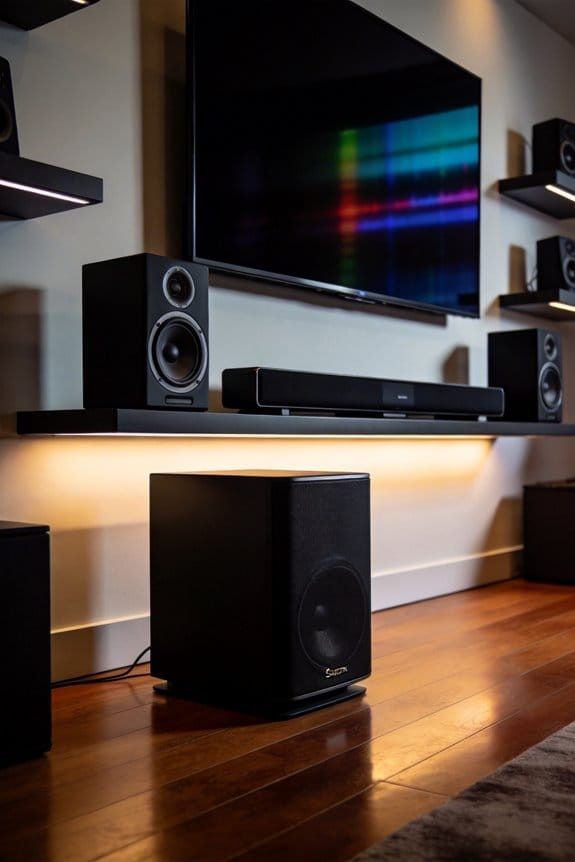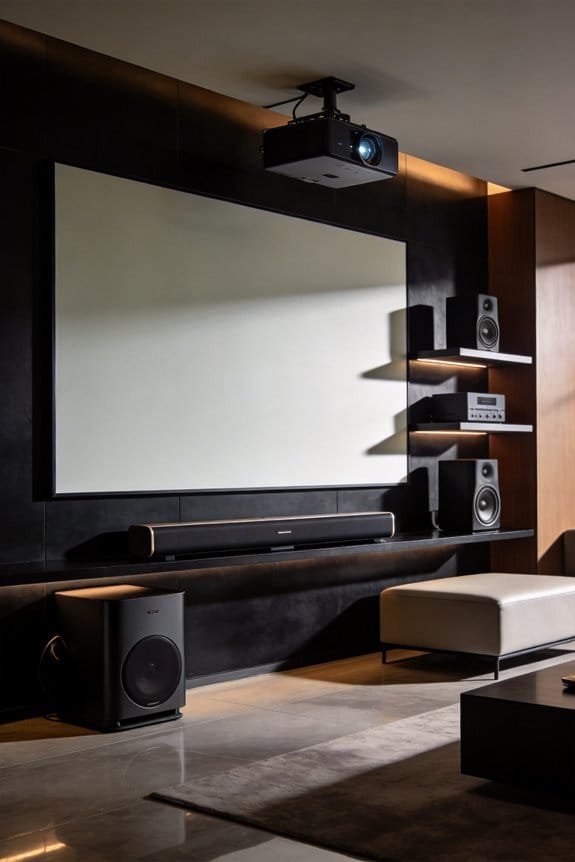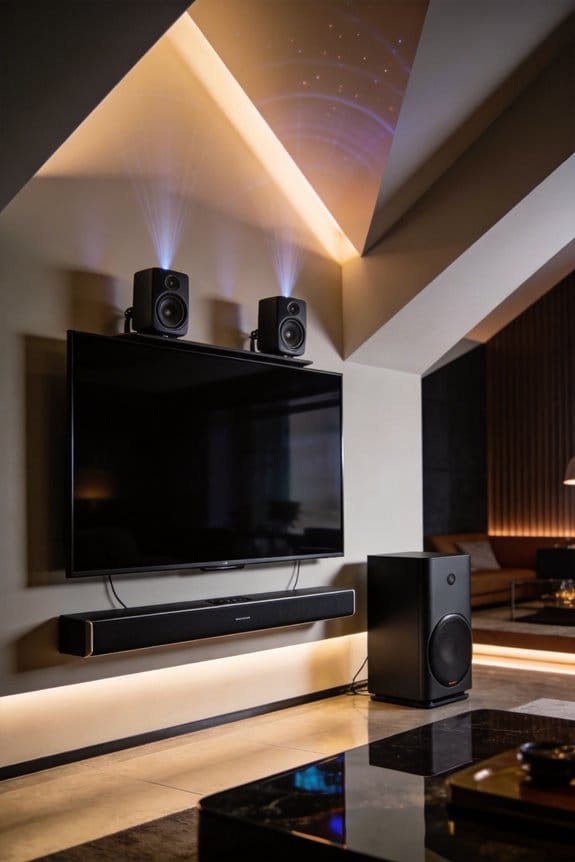
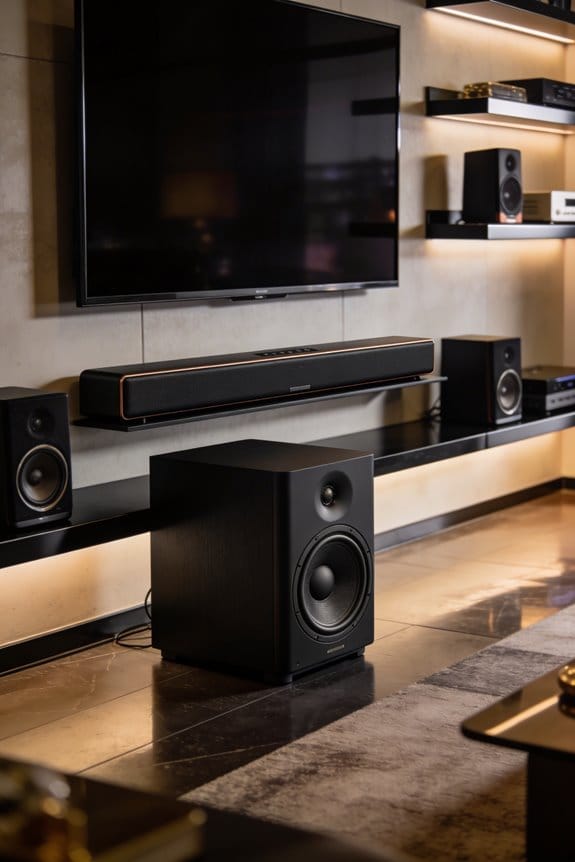

I’ll explain that matching your soundbar width to your TV width doesn’t improve stereo separation, because the physical distance between drivers—typically 65cm or less in most soundbars—creates fundamental acoustic limitations regardless of your TV’s size. The essential factor is actual speaker separation, not the soundbar-to-TV ratio, since your ears need distinct left and right channels spaced 2-3 meters apart for authentic stereo imaging, especially at vital frequencies around 1000 Hz. The sections below explore why separate speakers under €300 often outperform wider premium soundbars.
Key Takeaways
- Soundbar width relative to TV width does not significantly improve stereo separation or overall audio quality.
- Physical soundbar dimensions matter less than driver quality, acoustic design, and internal speaker configuration for sound performance.
- Even soundbars matching TV width face inherent limitations compared to speakers placed 2-3 meters apart for true separation.
- Stereo imaging depends on phase differences at critical frequencies around 1000 Hz, where soundbars struggle due to minimal driver spacing.
- Separate speakers provide superior stereo separation and soundstage regardless of TV width, outperforming wider soundbars in spatial audio.
Why Soundbar Width Alone Doesn’t Determine Stereo Quality
Ever thought a wider soundbar would automatically give you better stereo sound? It’s a common misconception, but the truth is, width alone doesn’t guarantee enhanced audio quality or a richer soundstage. Take it from someone who’s been down this road: the way your speakers are set up matters way more than their physical size. A 65cm soundbar, for instance, won’t deliver the same stereo separation as two separate speakers set 2-3 meters apart.
So, why does this matter? Your listening experience is shaped by more than just dimensions—it’s all about driver quality, acoustic design, and how sound bounces around your room. Physics puts some serious limits on what a single-unit soundbar can do. Many soundbars try to compensate for their size by using outward-facing drivers and psychoacoustic tricks, but those methods fall short compared to the real deal of having two distinct speakers creating space between them.
Here’s the trick: if you really want to experience true stereo sound, consider investing in separate speakers or even a multi-speaker setup. You might get more bang for your buck, especially if you enjoy music or movies where directionality in sound is key.
Honestly, it’s all about how sound interacts with the space around you and the equipment you’re using. If your soundbar sounds okay, that might be enough for casual listening. But if you’re aiming for that immersive experience, think beyond just the width of your setup.
The Physics Problem: How 65cm Spacing Limits Soundstage Width

Do you ever find yourself cranking up the soundbar instead of truly getting lost in a movie’s audio? It’s frustrating when you expect an immersive experience but feel like the sound is coming from a tin can.
While soundbars are known for their compact design and can pack a punch, the common 65cm width of many models brings in some physical limitations that can’t be ignored. When you place the left and right speakers just 65cm apart, the separation of sound waves is minimal. It’s way less than traditional speaker setups that are often 2-3 meters apart.
Here’s why this matters: that narrow soundstage can really restrict your listening experience. For those incredible lateral sounds and reflections that your brain relies on to perceive space, you need a bit more distance between those speakers. The truth is, when your speakers are so close together, even the best soundbar isn’t going to deliver that broad soundstage you’re hoping for. It produces the same limited width as smaller single units, and no fancy virtualization technology can change that.
So, if you’re thinking about getting a soundbar that matches the width of your TV, keep in mind that you may still face this core limitation. You might enjoy good sound, but it won’t fill the room the same way a properly spaced speaker setup can.
Upfiring Drivers and Psychoacoustic Tricks: Can Virtual Width Replace Real Separation?
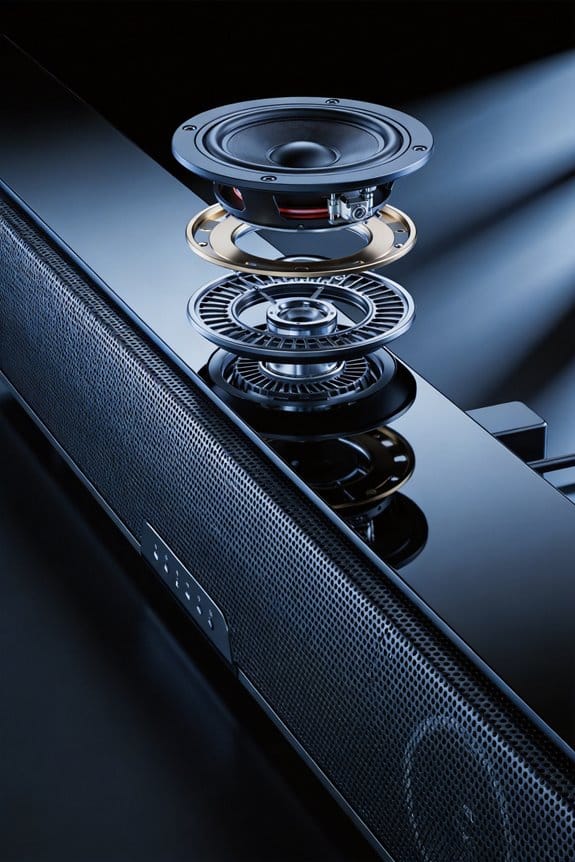
Can upward-firing speakers and some smart audio tricks really make your soundstage feel wider than it actually is? I’ve played around with a bunch of soundbars that use these cool upfiring techniques, including that Virtual Atmos feature that bounces sound off the ceiling to give a sense of height. These sound enhancements rely on angled speakers and digital processing to make you feel like the stereo width is bigger than it really is.
But here’s the kicker: These methods just can’t match real speaker separation. Your brain picks up on phase differences when sounds reach your ears, especially around that 1000 Hz sweet spot where we’re most sensitive to hearing. Sure, wall-bouncing and fancy algorithms might slightly widen the sound, but they hit a wall when it comes to physics. A 65cm soundbar isn’t going to create the same lateral reflections as speakers that are 200cm apart.
So, what can you do? If you want genuine sound separation, you might need to consider investing in actual speakers placed apart rather than just relying on a soundbar. Think about trying this setup for a more immersive experience. The best part is, it can really make a difference in how you enjoy your music and movies.
In short, while clever audio tricks can improve your listening experience, nothing beats the real deal when it comes to speaker separation. Are you ready to take the plunge and set up a real surround sound system?
The 1000 Hz Factor: Why Your Ear Spacing Matters More Than Soundbar Width
Have you ever wondered why some soundbars just don’t seem to deliver that rich stereo sound you expected? It turns out, how your ears are spaced is a huge factor in how you experience sound. Your ears sit about six inches apart on your head, and this measurement plays a role in how we perceive stereo sound, especially at certain frequencies.
Critical Frequency Range
Check this out: at around 1000 Hz, that six inches aligns perfectly with one-half of a wavelength of sound. This means our ears are super sensitive to differences in sound phase at this frequency. When sounds come from either extreme left or right, that 1000 Hz content hits each ear about 180 degrees out of phase. This is critical for creating a true stereo image.
Physical Limitations of Soundbars
Now, here’s the tricky part. Your ears are naturally wired to pick up on these phase differences, which is why the width of a soundbar isn’t everything when it comes to sound quality. Even a fancy 65cm soundbar can’t replicate the complex phase relationship that separate speakers can create. The way sound aligns or misaligns at 1000 Hz shows why many soundbars struggle to produce good stereo imaging—your ears can easily detect the phase problems.
So, why does this matter? Simply put, if you’re after great stereo sound, you might want to think beyond that shiny soundbar. Placing a few quality speakers around your room could make a world of difference.
In short, understanding how your ear’s spacing affects sound perception can help you make smarter audio choices. Have you thought about swapping out your soundbar for a better setup?
Separate Speakers vs. Premium Soundbars: Which Delivers Better Stereo Under €300?
When you’re considering home audio on a budget under €300, you’ve got an important decision to make: stick with a single premium soundbar or invest in a pair of separate speakers? Honestly, your best bet is to go for active speakers, like the IKEA Symfonisk pair, priced at €198. They offer real speaker separation that soundbars just can’t match. Those algorithms in soundbars can’t replicate the true sound experience you get from speakers placed apart from each other.
So, why does physical separation matter? It’s all about sound coherence. When you listen to music, your brain picks up on distinct left and right channels, especially when they’re coming from different enclosures. This means you’ll enjoy clearer, more detailed imaging than you would from drivers crammed into a single chassis. A soundbar might try to mimic stereo sound, but it’s simply not the same.
Let’s talk about bass for a second. While premium soundbars can do some tricky processing to make bass sound decent, separate speakers really shine here. They create genuine spatial bass effects that range from about 50 to 90 Hz simply because of their independent positioning. The physics of sound favors having separated speakers over any fancy processing.
In short, if you’re serious about enjoying your audio experience, think about going with a pair of separate speakers. This choice can lead to not just better sound, but a more enjoyable listening experience overall. Why compromise when you can have better clarity and depth?
Frequently Asked Questions
Should I Match My Soundbar Width Exactly to My TV Width?
I don’t recommend matching your soundbar width to your TV width. Audio performance depends on soundbar design and speaker separation, not visual aesthetics. Wider soundbars create better stereo imaging regardless of TV size, so prioritize maximum width available.
Do Wider Soundbars Always Produce Better Stereo Separation Than Narrower Models?
I’d say wider soundbars don’t guarantee better stereo separation. Speaker technology and soundbar design matter more—a narrow unit with outward-firing drivers often outperforms a wider bar with poor driver placement, since virtualization techniques compensate for physical limitations.
Can Room Size Affect How Well a Soundbar Creates Stereo Imaging?
Absolutely—room acoustics dramatically impact stereo imaging. I’ve found that early reflections from your walls, floor, and ceiling can smear the soundstage by 6-8 dB. Smart speaker placement helps, but physical limitations remain unavoidable.
Will Placing a Soundbar Off-Center Ruin the Stereo Effect Completely?
Yes, I’d say off-center placement severely disrupts soundstage perception and audio localization. Your brain relies on symmetric sound arrival from left and right channels. When the soundbar’s misaligned, you’ll lose proper stereo imaging and spatial cues entirely.
Do Expensive Soundbars Overcome Physical Width Limitations Better Than Budget Models?
No, expensive soundbars can’t defy physics. While premium features and advanced audio technology improve processing and driver quality, they cannot overcome fundamental physical width limitations that restrict genuine stereo separation regardless of price.