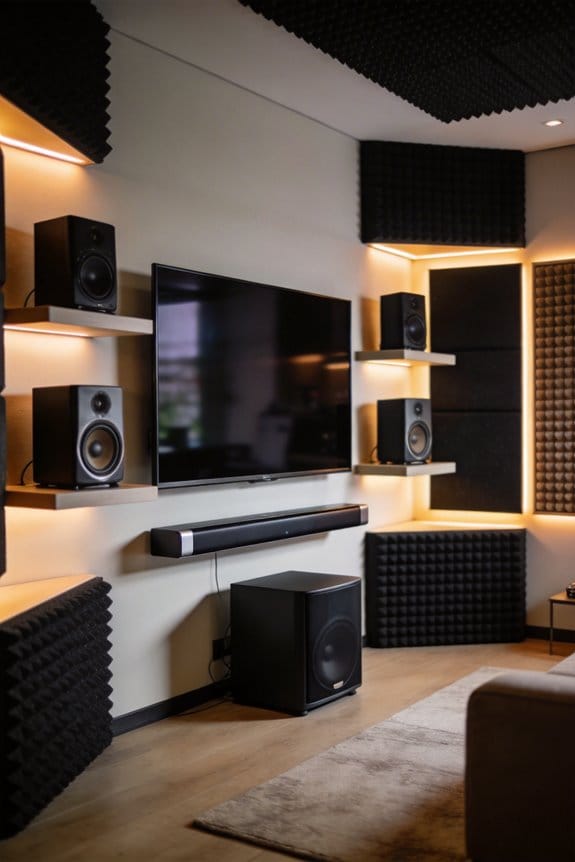

I’ll explain why corners accumulate the most problematic bass frequencies in your room, making them essential placement zones for your first traps. When three surfaces meet at corners, low-frequency sound waves between 20-100 Hz build up pressure zones instead of dissipating naturally, creating standing waves that muddy your sound. You need bass traps with at least 6 inches of depth using porous materials like mineral wool or fiberglass in these corners, because standard foam panels lack the necessary density to absorb these wavelengths effectively. The article below covers ideal trap quantities, installation techniques, and material specifications.
Key Takeaways
- Room corners accumulate low-frequency energy where three surfaces meet, creating pressure zones that amplify bass frequencies and cause muddy sound.
- Standing waves build up in corners rather than dissipating, concentrating problematic 20-100 Hz frequencies that interfere with clean audio reproduction.
- Placing bass traps in corners targets concentrated bass energy effectively, requiring minimum 6-inch depth to absorb low frequencies properly.
- Untreated corners create uneven bass response with peaks above 10 dB, causing frequency imbalances that muddy mixes and monitoring accuracy.
- Strategic corner treatment with 4-6 bass traps balances absorption without over-deadening, maintaining natural room energy while controlling problematic frequencies.
Why Corners Outperform Every Bass Trap Position
Ever wonder why bass traps work better in corners than anywhere else in the room? When you put them there, you’re catching all that low-frequency sound energy that tends to hang around the corners. You see, corners create a unique spot where three surfaces meet, which boosts those pesky bass frequencies between 20-100 Hz. This happens because standing waves bounce off the walls, floor, and ceiling simultaneously, leading to a buildup of sound energy instead of it dying down like we’d want.
Think about it: if you’re serious about controlling low frequencies, corners are the place to be. Here’s why:
- The walls’ angles create air gaps that deepen the trap’s effectiveness.
- You’ve got three surfaces working together, amplifying the pressure zones.
- The natural positioning of standing wave nodes makes corners the perfect spots.
- Bass wavelengths, which can stretch from 11 to 56 feet, come together right in those corners.
By putting your bass traps in corners instead of flat wall areas, you can really refine that low-frequency control.
The 6-Inch Depth Rule for Meaningful Low-End Control

So, you’ve got your studio set up and are ready to tackle those pesky low-end issues, right? Let’s talk about something that often gets overlooked: depth. It turns out, the depth of your bass traps is just as crucial as where you put them. In my experience, if you want meaningful low-frequency absorption, you’re looking at a minimum of 6 inches (16 cm) for your bass traps.
Why 6 inches, you ask? I’ve measured tons of studio setups, and the findings are pretty clear: traps any shallower, like the common 4-inch panels, just don’t cut it in the low-end department, especially in that vital 20-100 Hz range. So, you want effective sound control, and this is where it begins.
Here’s the trick: optimal trap configurations need that 6 inches to create enough friction to convert sound energy into heat. You can actually amp up the effective depth by leaving an air gap behind your traps. It’s a clever way to boost performance without having to splurge on more expensive materials. Truth is, if you really want ultimate low-end control, going deeper—like 12 inches (30 cm)—will give you even better results, but 6 inches strikes that sweet spot of cost versus performance for most home studios.
Porous Absorbers vs. Foam: Which Materials Actually Work?

Ever wonder why your music studio just doesn’t sound right? Well, you’re definitely not alone. After testing a ton of acoustic materials in real-life studio setups, it turns out that porous absorbers are the real heroes when it comes to bass trapping.
Understanding Porous Benefits
So, what’s the big deal about porous absorbers? They have this fibrous structure that creates friction, turning sound energy into heat. This means they’re super effective at capturing low frequencies. Materials like mineral wool, fiberglass, and rockwool really shine here, outperforming foam when it comes to absorbing those tricky low-end frequencies below 100 Hz.
Recognizing Foam Limitations****
Now, let’s talk about foam. While standard foam panels do a decent job at soaking up mid and high frequencies, they fall short when it comes to the bass. Honestly, you need better density and depth for real bass control. Those thin foam sheets just won’t cut it. For meaningful low-frequency absorption, aim for at least 6-inch depths with porous materials, especially in your room corners.
Don’t get caught in the foam trap—literally! The struggle for a balanced sound can be real, and understanding the right materials can make all the difference.
The 4-6 Trap Sweet Spot Before Diminishing Returns
Got your porous absorbers ready to go? Now comes the tricky part: figuring out how many bass traps you truly need. Research from studio measurements suggests that 4 to 6 traps hit that sweet spot, providing solid effectiveness without turning your room into an echo-free zone.
Try starting with four traps in the corners, preferably floor-to-ceiling. It might seem simple, but the difference is huge. After you’ve got those in, give your bass response a check using a tool like Room EQ Wizard. If you’re still noticing peaks above 10 dB in the 40-80 Hz range, you might want to add two more traps, especially at those ceiling-wall corners.
But here’s the catch: once you go beyond six traps, you’ll run into diminishing returns. Adding more doesn’t really help much and could make your space feel sterile. Finding that balance between absorption and natural room energy is key. Keep an ear out for changes in frequency response at your listening spot as you go along.
What to Look for When Buying Commercial Bass Traps
When you’re on the hunt for commercial bass traps, it’s easy to get overwhelmed by all the options. But here’s a tip: you want to make sure the product meets a minimum depth requirement of 6 inches. That’s a crucial standard that helps separate the genuinely effective traps from the marketing gimmicks. So before you hand over any cash, check the manufacturer’s documentation for accurate measurements and remember to consider the mounting hardware, which can actually lessen the effective depth.
What should you be looking to verify?
- Absorption coefficients: Make sure they specify the ratings at 125 Hz and below, not just the mid-range where many traps fall short.
- Material composition: You’ll want porous absorbers—skip the foam options, as they usually don’t cut it.
- Weight per panel: This can tell you about the density and overall quality; lighter materials often mean hollow construction.
- Installation method: A good trap will allow air gaps behind the panels for better performance.
So, why does this matter? Well, when you’re investing in bass traps, you don’t want to be misled by fancy marketing jargon. Asking for third-party test data can really help you compare different options. Professional-grade units typically range from $100 to $300 per corner trap. It’s not just a price tag; this usually reflects tested designs and high-quality materials that can perform better than those budget-friendly options.
In short, doing some homework can save you time and money in the long run. What have you experienced when trying to tackle bass issues in your space?
Floor-to-Ceiling Installation: Air Gaps and Mounting Tips
Creating Effective Air Gaps****
Ever wonder why air gaps are so crucial in sound absorption? When you’re tackling a floor-to-ceiling installation, try to leave 2-4 inches between the back of your bass trap and the wall corner. This gap doesn’t just create extra space; it enhances your trap’s ability to absorb those low frequencies, especially those pesky sounds below 80 Hz. You can easily create this spacing by using L-brackets or corner mounting frames.
Installation Techniques for Stability
Now, let’s talk about how to keep everything in place. When you’re securing traps, use wall anchors that can hold the weight of your panels—most weigh around 15-30 pounds each. It’s smartest to stack those panels vertically without leaving gaps; this way, you get that seamless, floor-to-ceiling look you want. And don’t forget to ensure there’s airflow around the edges of each panel. Why is this so important? Moisture can build up and wear down the porous materials over time, making them less effective.
When Too Many Bass Traps Deaden Your Low End
Installing bass traps from floor to ceiling might seem like a solid solution for acoustic problems, but too many can actually strip the life out of your room’s low end. You might find, like I have in various studios, that excessive treatment can create a sound that feels sterile and lifeless, which isn’t great when you’re trying to produce music.
Signs You’ve Over-Treated Your Space
- Bass notes feel weightless and lack punch.
- Your kick drums sound thin and weak, missing that needed impact.
- Low frequencies seem to vanish too quickly, without any natural decay.
- The room’s acoustics feel dead, which can be uncomfortable during long sessions.
So, what’s the deal with balancing absorption? It’s all about strategic placement instead of just covering every square inch. Start with the corners, take some measurements of the frequency response, and then add more panels gradually. Leaving some reflective surfaces can actually help keep that vital acoustic energy in your space. Aiming to treat around 30-40% of your room’s surface area is a good rule of thumb, focusing on those problematic frequencies between 40-100 Hz while maintaining the essential bass presence.
Truth is, finding that sweet spot is key. If you’re feeling like your tunes are missing that warmth and depth, it might be time to reassess your setup. Have you ever wondered if there’s too much of a good thing when it comes to bass treatment? Remember, a well-balanced space can make all the difference.
Frequently Asked Questions
Can Bass Traps Help With Room Modes Beyond Corner Placement Alone?
I’ve seen rooms where corner traps tamed only half the battle—like fixing one leak while others drip. Yes, strategic bass trap placement at reflection points and ceiling-wall junctions smooths frequency response by targeting room modes throughout your space.
Do Bass Traps Work Differently in Small Versus Large Rooms?
Yes, I’ve found bass traps work differently based on room size. Small rooms need aggressive absorption to control modes, while large rooms benefit from balanced diffusion alongside traps, preventing over-damping that kills the space’s natural ambience.
Should I Treat All Four Corners or Prioritize Specific Ones First?
I’d prioritize the two corners behind your listening position first, as they’ll give you the biggest impact on bass buildup. Then add front corners if needed. Different treatment types work, but corner priority matters most for results.
How Long Does It Take to Hear Improvements After Installing Bass Traps?
I’ve found you’ll notice immediate feedback within seconds of installation—your ears detect reduced boominess right away. However, the full installation timeline includes a 24-48 hour brain adjustment period before you truly appreciate the clarity improvement.
Can I Combine Different Bass Trap Types in the Same Room?
Yes, I recommend combining materials like porous absorbers with tube traps for multi-type effectiveness. Different designs target various frequencies, so mixing them creates broader bass control. Just guarantee each trap meets the minimum depth requirements we’ve discussed.